


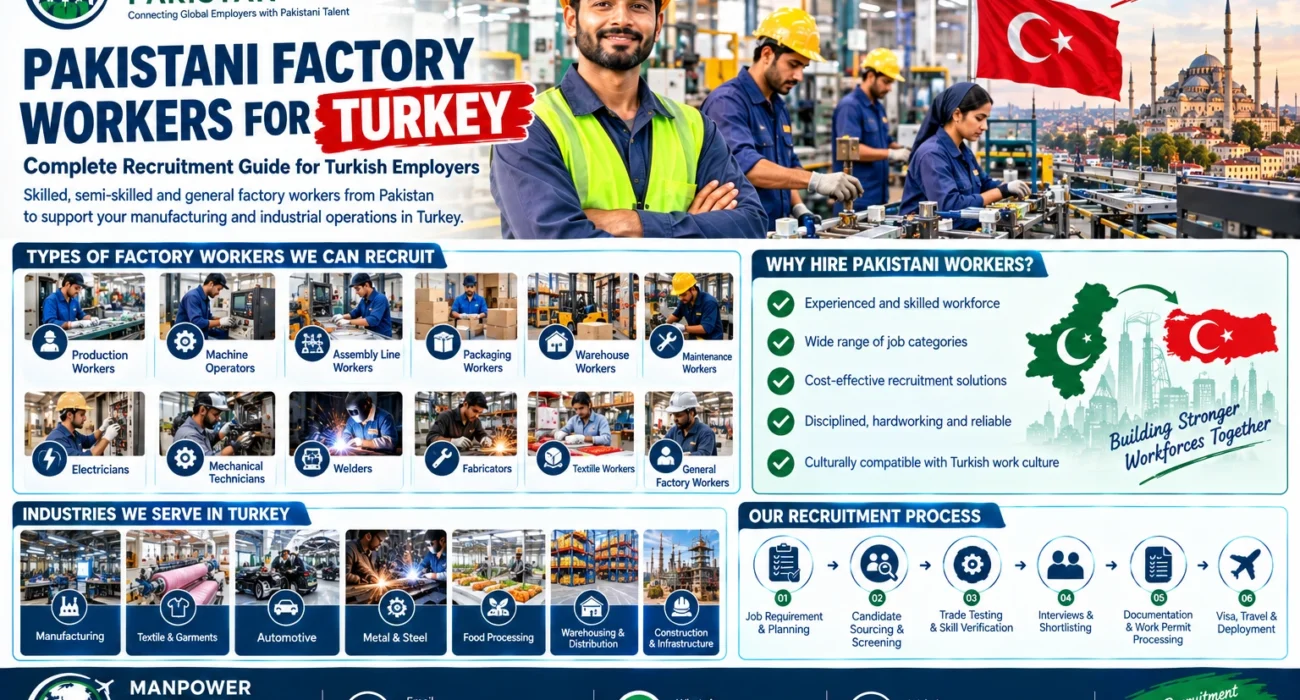
Turkey has a large and diverse manufacturing sector, creating workforce requirements across production, assembly, packaging, warehousing, maintenance, textiles, food processing, automotive, metalwork, and other industrial activities.
For Turkish companies facing specific workforce shortages, recruiting Pakistani factory workers for Turkey can be one possible international recruitment route. The key is to define the job properly, identify candidates with relevant experience, verify their skills, and complete the applicable work authorization process.
Manpower Agency Pakistan provides overseas manpower recruitment services for international employers seeking skilled, semi-skilled, and general workers from Pakistan. Its published Turkey recruitment content covers sectors including manufacturing and industrial work.
This guide explains how Turkish employers can approach the recruitment of Pakistani factory workers, what positions may be recruited, how candidates can be screened, and what employers should consider before deployment.
What Are Pakistani Factory Workers?
“Factory workers” covers a wide range of jobs. A Turkish employer should avoid using only the general term factory workers when preparing a manpower requirement.
The recruitment requirement should identify the exact position, responsibilities, experience, technical skills, and working conditions.
Depending on the factory, Pakistani workers may be considered for positions such as:
- Production workers
- Assembly line workers
- Machine operators
- Packaging workers
- Warehouse workers
- Material handlers
- Quality-control assistants
- Maintenance workers
- Electricians
- Mechanical technicians
- Welders
- Fabricators
- CNC machine operators
- Textile workers
- Sewing machine operators
- Food-processing workers
- Industrial cleaners
- General factory workers
The availability and suitability of candidates will depend on the specific job requirements and the applicable Turkish rules for employing foreign nationals.
Why Recruit Pakistani Factory Workers for Turkey?
Turkish employers considering international recruitment generally need to assess candidates according to the actual requirements of the vacancy.
Pakistan has a large labour market with workers experienced in manufacturing, construction, technical trades, logistics, textiles, and other industries. Manpower Agency Pakistan’s published recruitment services include skilled, semi-skilled, and general workers as well as candidate sourcing, screening, trade testing, bulk recruitment, and documentation support.
1. Different Skill Levels Are Available
A factory may require several categories of employees at the same time.
For example, an industrial manufacturer might require:
| Position | Possible Requirement |
|---|---|
| Production Workers | Assembly and production operations |
| Machine Operators | Operating designated production machinery |
| Welders | Metal fabrication and industrial work |
| Electricians | Electrical installation and maintenance |
| Mechanical Technicians | Machinery maintenance |
| Packaging Workers | Product packaging and preparation |
| Warehouse Workers | Material movement and stock handling |
| Quality Assistants | Basic inspection and production checks |
| General Workers | Supporting production operations |
The exact workforce should be selected according to the employer’s job descriptions rather than simply recruiting a large number of workers under one general title.
Which Factory Industries in Turkey May Recruit Pakistani Workers?
Different manufacturing businesses have different workforce requirements.
Potential areas include:
Manufacturing
Manufacturing companies may require production workers, machine operators, technicians, assemblers, welders, and maintenance personnel.
Textile and Garments
Textile businesses may require sewing machine operators, garment workers, fabric handlers, quality-control workers, and production assistants.
Automotive
Automotive manufacturing and supplier businesses may require assembly workers, machine operators, welders, mechanics, electricians, and warehouse personnel.
Metal and Steel
Metalworking businesses may require welders, fabricators, machine operators, maintenance workers, and production workers.
For employers needing specialist technical workers, you can also read the guide on how to hire Pakistani welders for Turkey.
Food Processing
Food manufacturing businesses may require production workers, packaging workers, warehouse workers, machine operators, and cleaning staff.
Warehousing and Distribution
Factories with large supply-chain operations may require warehouse workers, material handlers, forklift operators, and logistics personnel.
How to Hire Pakistani Factory Workers for Turkey
A structured recruitment process makes it easier for a Turkish company to communicate its requirements and evaluate candidates.
Step 1: Prepare a Detailed Manpower Requirement
The first step is to prepare a clear job order.
Instead of simply saying:
“We need 100 factory workers.”
provide details such as:
- Number of workers
- Job titles
- Production department
- Required experience
- Required technical skills
- Education requirements
- Age requirements, where legally relevant
- Working hours
- Shift system
- Salary
- Overtime arrangements
- Accommodation
- Food or meal arrangements
- Transportation
- Job location
- Contract period
- Expected joining date
- Interview requirements
- Trade-testing requirements
For example:
50 Production Workers + 20 Machine Operators + 10 Welders + 10 Electricians + 10 Warehouse Workers
is much more useful than a general request for 100 factory workers.
Step 2: Work With a Pakistani Recruitment Agency
After preparing the manpower requirement, the Turkish employer can contact a Pakistani overseas recruitment agency.
A recruitment partner may assist with:
- Candidate sourcing
- CV screening
- Experience verification
- Candidate shortlisting
- Employer interviews
- Trade testing
- Skill verification
- Documentation coordination
- Visa-related support
- Work permit coordination
- Pre-departure arrangements
- Deployment coordination
Manpower Agency Pakistan’s published services include overseas manpower recruitment and support for international employers seeking Pakistani workers.
For larger factory requirements, employers can also review bulk manpower recruitment services.
Step 3: Source Factory Workers in Pakistan
Once the job requirement is received, candidates can be sourced according to the positions required.
For example, if a Turkish automotive factory needs 50 production workers and 20 machine operators, the recruitment process should separately identify candidates for each category.
Production Workers
Screening can focus on:
- Previous factory experience
- Production-line experience
- Ability to work shifts
- Workplace discipline
- Basic safety awareness
- Physical requirements of the job
Machine Operators
Employers may need candidates with:
- Specific machine experience
- Production experience
- Machine-operation knowledge
- Safety awareness
- Maintenance knowledge where required
Technical Workers
For electricians, welders, mechanics, and other technical workers, practical testing may be particularly useful.
Step 4: Screen Candidates Before Employer Interviews
Candidate screening helps reduce the number of unsuitable profiles reaching the employer.
A recruitment team may review:
- Previous employment
- Years of experience
- Job responsibilities
- Technical skills
- Qualifications
- Certificates
- Previous factories or projects
- Passport information
- Availability
- Relevant references
The important point is to verify what the candidate actually did.
For example, someone may have the job title Machine Operator, but the employer should know what machine the candidate operated, for how long, and what responsibilities were involved.
You can learn more about candidate sourcing and screening services for overseas recruitment.
Step 5: Conduct Trade Testing and Practical Assessments
For technical factory positions, an interview alone may not provide enough information about a candidate’s practical ability.
A practical assessment may be appropriate for:
- Welders
- Electricians
- Machine operators
- CNC operators
- Mechanical technicians
- Fabricators
- Maintenance workers
Pakistan’s Emigration Rules provide that, after registration of an overseas demand, an Overseas Employment Promoter should ensure proficiency in the relevant trade according to the foreign employer’s requirements, arranging trade testing where applicable at an approved trade-test centre.
Manpower Agency Pakistan also provides trade testing and skill verification as part of its recruitment services.
Step 6: Arrange Interviews With Turkish Employers
After screening and practical assessment, shortlisted candidates can be presented to the Turkish employer.
Interviews may be conducted through:
- Video interviews
- Online meetings
- Telephone interviews
- Face-to-face interviews
- Employer representatives visiting Pakistan
The employer should discuss the actual job rather than simply asking general interview questions.
Important subjects include:
- Previous factory experience
- Production responsibilities
- Shift experience
- Technical knowledge
- Workplace safety
- Previous employers
- Salary expectations
- Availability
- Willingness to relocate to Turkey
Step 7: Finalize Salary and Employment Conditions
Before candidates are finally selected, employment conditions should be clearly communicated.
The package may include:
- Basic salary
- Overtime arrangements
- Working hours
- Shift arrangements
- Weekly rest
- Accommodation
- Transportation
- Meals or meal allowance
- Medical arrangements
- Contract duration
- Location of employment
- Other applicable benefits
The employment conditions should be consistent with the written employment agreement and applicable Turkish requirements.
Turkish Work Permit Requirements for Pakistani Factory Workers
One of the most important parts of recruiting Pakistani factory workers for Turkey is obtaining the appropriate authorization to work.
Turkey’s Ministry of Labour and Social Security publishes work-permit evaluation criteria for foreign workers. Current criteria include employment, financial eligibility, and salary requirements, with specific rules and exceptions depending on the employer and worker.
For example, the current general criteria state that, for workplaces subject to the relevant balance-sheet procedure, an employer generally needs to employ at least five Turkish citizens for each foreign worker for whom a work permit application is made, subject to specified exceptions. Financial and salary criteria also apply in relevant cases.
This is important for Turkish factories: an employer should check its eligibility before promising a position to a large group of Pakistani workers.
The Turkish Ministry’s 2026 information brochure also covers foreign-worker access to the labour market, work-permit applications, evaluation criteria, and obligations of foreign workers.
Employers should consult the official Turkish Ministry of Labour and Social Security work-permit information before beginning recruitment.
What Should Turkish Employers Check Before Hiring?
Before recruiting Pakistani factory workers, employers should check several areas.
Employer Eligibility
Confirm that the Turkish company meets the applicable requirements for employing foreign workers.
Job Eligibility
Confirm that the proposed occupation can be filled by a foreign worker under the applicable rules.
Salary Requirements
Make sure the proposed salary meets any applicable work-permit criteria.
Workforce Requirements
Check the applicable employment and financial criteria before submitting applications.
Worker Qualifications
Verify that each candidate actually has the experience required for the position.
Documentation
Prepare the required employment and work-permit documentation.
Accommodation and Working Conditions
Clearly communicate where and how the workers will live and work.
Documents for Pakistani Factory Workers
The exact documentation depends on the position, employer, and applicable Turkish and Pakistani procedures.
Potential documents can include:
- Passport
- CV
- Employment history
- Educational certificates
- Technical certificates
- Trade-test results
- Previous employment evidence
- Medical documentation where required
- Employment contract
- Work-permit documents
- Visa-related documents
- Other documents requested by the relevant authorities
Employers should confirm the final requirements before recruitment begins.
For recruitment-related paperwork, Manpower Agency Pakistan provides visa and documentation support.
Pakistan-Side Overseas Employment Process
Turkish employers recruiting workers from Pakistan should also consider the Pakistani overseas employment framework.
The Bureau of Emigration & Overseas Employment (BEOE) regulates important aspects of overseas employment and maintains an official list of Overseas Employment Promoters.
Employers can use the BEOE official website to review information about overseas employment and recruitment procedures.
The BEOE also provides an official list of Overseas Employment Promoters, which employers can use when checking recruitment providers.
Using the appropriate recruitment channel and following the applicable procedures helps keep the recruitment process organized.
Bulk Recruitment of Pakistani Factory Workers for Turkey
Some Turkish manufacturers may need a large number of workers for a new factory, production expansion, seasonal demand, or industrial project.
For example, a factory could require:
| Position | Workers |
|---|---|
| Production Workers | 50 |
| Machine Operators | 25 |
| Packaging Workers | 20 |
| Welders | 10 |
| Electricians | 5 |
| Warehouse Workers | 15 |
| Maintenance Technicians | 5 |
| Total | 130 |
Rather than managing every position separately, the employer can provide one complete manpower requirement.
The recruitment process can then be organized into:
Job Requirement → Candidate Sourcing → Screening → Testing → Employer Interviews → Selection → Documentation → Work Authorization → Visa Procedures → Travel → Deployment
For large requirements, bulk manpower recruitment can help organize the recruitment around the employer’s workforce requirements.
Example: Turkish Factory Hiring 100 Pakistani Workers
Imagine a Turkish manufacturing company is expanding its production facility and needs 100 workers from Pakistan.
The company could divide its requirement into:
- 40 production workers
- 20 machine operators
- 15 packaging workers
- 10 warehouse workers
- 5 welders
- 5 electricians
- 5 maintenance workers
Stage 1 — Job Requirement
The Turkish company provides detailed job descriptions and employment conditions.
Stage 2 — Candidate Sourcing
Candidates are sourced in Pakistan according to each job category.
Stage 3 — Screening
Experience, qualifications, documents, and employment history are reviewed.
Stage 4 — Practical Testing
Technical candidates are tested where appropriate.
Stage 5 — Employer Interviews
The Turkish employer interviews shortlisted candidates.
Stage 6 — Selection
The employer confirms the selected workers.
Stage 7 — Documentation
The required employment and recruitment documents are prepared.
Stage 8 — Work Authorization
The employer and candidates follow the applicable Turkish work-permit procedures.
Stage 9 — Visa and Travel
Candidates complete the applicable procedures before travelling.
Stage 10 — Deployment
Workers travel to Turkey and join the employer according to the agreed employment arrangements.
Common Mistakes When Hiring Factory Workers From Pakistan
Hiring Workers Under a Vague Job Title
“Factory worker” is too broad for many recruitment projects.
Specify the actual role.
Selecting Candidates Only From CVs
A CV does not always demonstrate practical ability. Testing can be useful for technical positions.
Ignoring Work-Permit Criteria
Turkish work-permit rules include employer and worker evaluation criteria. These should be checked before recruitment begins.
Changing Salary After Selection
Salary, accommodation, working hours, and other major conditions should be clear before workers accept the employment offer.
Recruiting Without Checking Experience
A worker’s previous job title does not necessarily tell the employer what tasks the person actually performed.
Delaying Documentation
International recruitment involves multiple stages. Work authorization and documentation should be considered from the beginning.
Recruiting Large Numbers Without a Structured Plan
A requirement for 100 or 200 workers should be divided into clear job categories, qualifications, testing requirements, and deployment stages.
How to Choose a Pakistani Recruitment Agency
Before working with a recruitment agency, Turkish employers can ask:
Does the agency recruit for the required industry?
Manufacturing recruitment may require different candidate networks from construction or hospitality recruitment.
Can the agency recruit in bulk?
This is important when a factory needs dozens or hundreds of workers.
How are candidates screened?
Ask how experience, qualifications, certificates, and previous employment are checked.
Can practical testing be arranged?
This is particularly important for technical workers.
Does the agency provide documentation support?
Clarify which recruitment and documentation stages the agency will handle.
Does the agency understand overseas employment procedures?
Pakistan’s BEOE provides the official framework and information for overseas employment and maintains its OEP directory.
Can the agency coordinate employer interviews?
A good recruitment process should make communication between the Turkish employer and Pakistani candidates clear and organized.
Why Turkish Factories May Consider Recruiting From Pakistan
International recruitment can be useful when an employer has a clearly defined workforce requirement and needs to look beyond the domestic candidate pool.
For Turkish factories, the recruitment process can be organized according to:
- Industry
- Production department
- Job category
- Number of workers
- Experience
- Technical skills
- Salary
- Working hours
- Shift requirements
- Accommodation
- Location
- Testing requirements
- Deployment schedule
Manpower Agency Pakistan’s Turkey recruitment material describes recruitment support for sectors including manufacturing and other industries, with services covering candidate sourcing, screening, trade testing, bulk recruitment, and documentation support.
How Manpower Agency Pakistan Can Help
Manpower Agency Pakistan works with international employers seeking Pakistani workers for overseas employment.
Its published services include:
- Skilled workers
- Semi-skilled workers
- General workers
- Factory workers
- Technical workers
- Candidate sourcing
- Candidate screening
- Trade testing
- Skill verification
- Bulk manpower recruitment
- Visa and documentation support
- Deployment coordination
For Turkish employers, the recruitment process can be structured around the factory’s exact requirements rather than using a one-size-fits-all approach.
If you are looking for a broader overview, read the Turkey Manpower Recruitment from Pakistan: Complete Guide.
Employers can also review Pakistan Manpower Recruitment Agency for Turkey to understand the recruitment process in more detail.
Start Hiring Pakistani Factory Workers for Turkey
If your Turkish factory needs Pakistani workers, begin by preparing a detailed manpower requirement.
Include:
- Number of workers
- Job titles
- Required experience
- Technical qualifications
- Salary
- Working hours
- Shift arrangements
- Accommodation
- Job location
- Contract duration
- Testing requirements
- Interview requirements
- Expected joining date
Once the requirement is prepared, a Pakistani recruitment partner can begin candidate sourcing and screening.
For recruitment enquiries, contact Manpower Agency Pakistan:
Email: info@manpoweragencypakistan.com
WhatsApp: +92 333 3680169
Website: Manpower Agency Pakistan
Contact: Contact Manpower Agency Pakistan
Frequently Asked Questions
Can Turkish companies hire Pakistani factory workers?
Turkish companies can recruit foreign workers subject to the applicable Turkish work-permit and employment rules. Employers should verify their eligibility and the requirements for the particular positions before recruitment begins.
What types of Pakistani factory workers can be recruited for Turkey?
Depending on the employer’s requirements, positions may include production workers, machine operators, packaging workers, warehouse workers, welders, electricians, mechanics, technicians, textile workers, and other factory-related positions.
Do Pakistani factory workers need a Turkish work permit?
Foreign workers generally require the appropriate Turkish work authorization unless a specific exemption applies. The applicable requirements depend on the worker, employer, occupation, and circumstances. Employers should consult the Turkish Ministry’s current guidance before starting the process.
Can Turkish companies recruit factory workers in large numbers from Pakistan?
Large recruitment projects can be organized around a detailed manpower requirement. The recruitment process can divide workers into job categories and apply separate screening or testing criteria where appropriate.
Should factory workers be trade tested?
Trade testing can be particularly useful for technical positions such as welders, electricians, machine operators, and maintenance technicians. Pakistan’s Emigration Rules provide for trade testing where applicable according to the foreign employer’s requirements.
How can Turkish employers find Pakistani factory workers?
Employers can prepare a detailed manpower requirement and work with a Pakistani recruitment provider to source, screen, test, interview, and process suitable candidates according to the applicable procedures.
Can Manpower Agency Pakistan recruit factory workers for Turkey?
Manpower Agency Pakistan’s published services include overseas recruitment, skilled and semi-skilled workers, factory workers, candidate sourcing and screening, trade testing, bulk recruitment, and visa/documentation support.
Conclusion
Recruiting Pakistani factory workers for Turkey requires careful planning rather than simply requesting a large number of workers.
Turkish employers should identify the exact job categories, define the required skills, source appropriate candidates, verify experience and documents, conduct practical assessments where necessary, interview shortlisted workers, and confirm the applicable Turkish work-permit requirements.
For large manufacturing projects, a structured recruitment process can also make it easier to manage multiple categories of workers at the same time.
If your Turkish company needs Pakistani factory workers, production workers, machine operators, technicians, welders, electricians, or other industrial manpower, Manpower Agency Pakistan can discuss your manpower requirement and the recruitment process.
Email: info@manpoweragencypakistan.com
WhatsApp: +92 333 3680169