



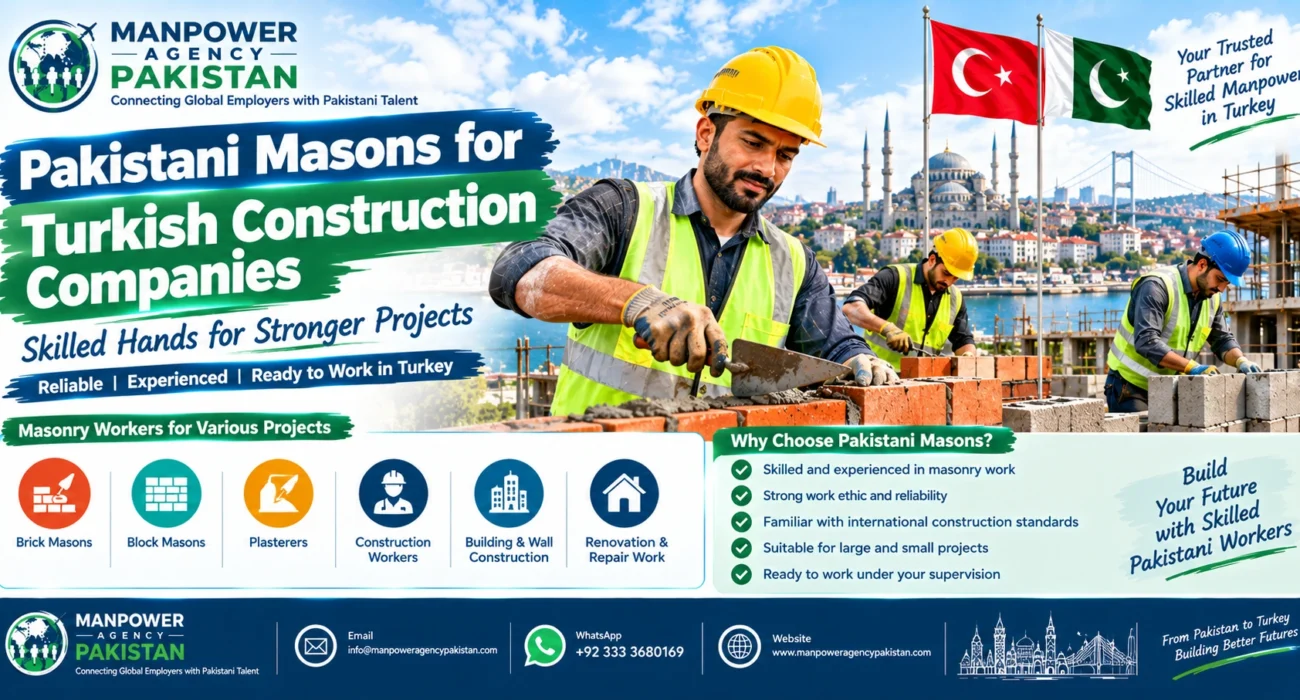
Turkey’s construction industry relies on workers who can deliver quality workmanship, follow project specifications, and complete tasks according to the construction schedule. For contractors managing residential buildings, commercial developments, infrastructure projects, and renovation work, finding experienced masons is an important part of workforce planning.
Hiring Pakistani masons for Turkish construction companies can be an option for employers seeking candidates with practical masonry experience and a willingness to work on overseas projects. Through a structured recruitment process, employers can identify suitable workers, assess their technical skills, and coordinate the documentation required for employment in Turkey.
This guide explains how Turkish construction companies can recruit Pakistani masons, what skills to look for, how candidate screening works, and which legal requirements employers should check before arranging deployment.
Why Turkish Construction Companies May Consider Pakistani Masons
Masonry work requires practical ability, attention to detail, and an understanding of construction methods. Depending on the project, employers may need workers who can perform brickwork, blockwork, plastering, wall preparation, or related building tasks.
Pakistani candidates with relevant construction experience may be suitable for positions such as:
- Brick masons
- Block masons
- Concrete block workers
- Plastering workers
- Building and wall construction workers
- General construction workers with masonry experience
- Masonry team leaders with proven site experience
The suitability of each candidate depends on the employer’s requirements, previous experience, technical ability, and ability to work safely on the job.
For Turkish contractors, the objective should be to recruit workers who match the project’s specifications rather than simply filling vacancies quickly. Clear job descriptions and practical assessments help employers make better hiring decisions.
What Skills Should Employers Look for in Pakistani Masons?
Before starting recruitment, construction companies should define the skills required for each position. Masonry duties can vary considerably between residential construction, commercial projects, industrial buildings, and renovation work.
1. Bricklaying and Blockwork
Experienced masons should understand how to lay bricks or blocks according to the project’s requirements. Employers may assess a candidate’s ability to maintain straight lines, consistent joints, correct alignment, and appropriate mortar application.
A practical test can help determine whether the candidate can produce work that meets the required quality standard.
2. Plastering and Surface Preparation
Some projects require masons who can prepare walls and apply plaster to achieve a suitable finish. Employers should specify whether the job involves internal plastering, external surfaces, repair work, or other finishing duties.
Candidates should be assessed according to the techniques and finish standards required on site.
3. Reading Measurements and Construction Instructions
Masons often need to follow measurements, drawings, site instructions, and construction specifications. Employers should determine the level of technical understanding needed for the role.
For more specialised work, experience interpreting construction drawings or working with particular building systems may be important.
4. Tool Handling and Worksite Safety
Candidates should demonstrate safe use of common masonry tools and understand the importance of personal protective equipment, housekeeping, and site safety instructions.
Employers should also provide the required site induction and safety training after recruitment.
5. Teamwork and Productivity
Masonry work is often coordinated with other trades, including carpenters, steel fixers, electricians, plumbers, and general construction workers. Employers should consider whether candidates can follow supervisors’ instructions, coordinate with colleagues, and work according to the project’s schedule.
How to Recruit Pakistani Masons for Turkish Construction Companies
A structured recruitment process helps employers identify suitable candidates and manage hiring more efficiently.
Step 1: Prepare a Clear Job Order
Start by documenting the number of masons required and the exact duties involved.
Your job order should include:
- Number of workers required
- Type of masonry work
- Minimum relevant experience
- Required technical skills
- Salary and payment arrangements
- Working hours and overtime conditions
- Contract duration and work location
- Accommodation and transport arrangements, where applicable
- Expected start date and project schedule
The more clearly the requirements are defined, the easier it becomes to identify candidates who match the project.
Step 2: Contact a Pakistan Recruitment Agency
A recruitment agency can help employers source candidates, organise initial screening, coordinate interviews, and assist with recruitment documentation within the agreed scope of services.
Turkish companies can explore Manpower Agency Pakistan’s overseas manpower recruitment services to discuss their workforce requirements.
When contacting a recruitment provider, share the job order, number of vacancies, required experience, salary range, and expected recruitment schedule. These details help establish the scope of the recruitment project.
Employers should independently verify any recruitment licence or authorisation required for the particular arrangement before entering into an agreement.
Step 3: Shortlist Candidates with Relevant Experience
The next step is to identify candidates whose previous work matches the project requirements.
Candidate screening may include reviewing CVs, discussing previous construction projects, checking experience certificates where available, and confirming the specific masonry tasks the candidate has performed.
For example, a contractor recruiting brick masons for a large building project may need candidates with substantial bricklaying experience. A renovation company may place greater emphasis on plastering, repairs, and finishing work.
Explore candidate sourcing and screening services to learn more about this stage of recruitment.
Step 4: Arrange Practical Masonry Tests
For construction positions, practical testing can be more informative than relying on a CV alone.
Depending on the job, a trade test may assess whether the candidate can:
- Lay bricks or blocks to the required alignment.
- Apply mortar correctly.
- Maintain consistent joints.
- Follow measurements and work instructions.
- Prepare and finish surfaces.
- Use tools safely and efficiently.
The assessment should reflect the actual duties the worker will perform in Turkey. Employers can explore trade testing and skill verification when planning a recruitment project.
Step 5: Conduct Interviews and Confirm Employment Terms
Once candidates pass the required assessments, employers can interview shortlisted applicants and confirm their suitability.
Before final selection, make sure the worker understands the proposed salary, working hours, duties, contract duration, work location, accommodation arrangements, and other relevant conditions.
Employment terms should be documented accurately and comply with applicable Turkish labour law.
Step 6: Check Turkish Work-Permit Requirements
Pakistani workers must not begin employment in Turkey without the work authorisation required under Turkish law.
Turkey’s Ministry of Labour and Social Security explains the work-permit process through its official Directorate General of International Labour Force website and its work-permit guidance.
For applications from abroad, the process generally involves steps by the worker through the relevant Turkish foreign mission and by the employer in Turkey. The exact requirements and documents depend on the circumstances and rules in force.
Employers should review the latest official instructions before submitting applications, making travel arrangements, or promising a deployment date. A recruitment agency cannot guarantee that a work permit or visa will be approved.
Step 7: Coordinate Travel and Site Onboarding
Once the necessary approvals and documents are confirmed, the employer and recruitment partner can coordinate the remaining deployment arrangements.
Before workers travel, confirm that they understand their employment contracts, job duties, reporting location, accommodation arrangements, and travel details.
After arrival, the employer should complete required employment formalities and provide site orientation, safety instructions, and information about workplace procedures.
Documents Turkish Employers Should Prepare
The documents required depend on the current application procedure and the circumstances of the employer and worker. A recruitment project may involve:
- Employer and company information
- A formal job offer and employment contract
- Candidate passport and identity details
- CV and relevant work experience records
- Qualifications or certificates, where applicable
- Work-permit application documents
- Visa and travel documentation, as required
- Additional information requested by the relevant authorities
This is a general planning list, not a definitive legal checklist. Employers should confirm the exact requirements through official Turkish sources before submitting an application.
For Pakistani overseas-employment procedures, the Bureau of Emigration & Overseas Employment provides official information. Employers and workers can also consult the list of active Overseas Employment Promoters to check relevant recruitment licensing details.
The required Pakistani emigration procedures should be completed where applicable. Candidate selection alone does not replace these formalities or Turkish work authorisation.
Benefits of Structured Mason Recruitment
A planned recruitment process can help construction companies manage workforce requirements more effectively.
Better Matching of Skills to the Project
When job requirements are clearly defined, employers can shortlist candidates with experience relevant to the work. This helps avoid selecting workers whose skills do not match the project’s needs.
More Consistent Candidate Assessment
Using the same interview questions and practical test criteria makes it easier to compare candidates fairly. Employers can assess each applicant against the same technical and safety standards.
Improved Recruitment Coordination
A recruitment partner can help organise candidate information, interviews, skill assessments, and agreed documentation tasks. This can be especially useful when multiple vacancies must be filled.
Support for Larger Construction Teams
Some projects require masons alongside steel fixers, shuttering carpenters, electricians, plumbers, and other trades. Employers planning a larger workforce can explore bulk manpower recruitment services.
Recruitment timelines should include time for screening, testing, documentation, and official approvals. Hiring plans should not depend on unconfirmed permit decisions.
How to Choose a Recruitment Partner for Pakistani Masons
Before appointing a recruitment provider, Turkish construction companies should consider the following points.
Experience with construction roles: Ask how candidates are sourced and how masonry experience is evaluated.
Practical skill verification: Confirm whether trade tests can be arranged and what criteria are used to assess candidates.
Transparent service agreement: Clarify the recruitment scope, fees, responsibilities, communication process, and any replacement terms.
Accurate candidate information: Ensure that qualifications, employment history, and skill claims are checked appropriately.
Documentation coordination: Confirm which documents the provider can help organise and which responsibilities remain with the employer or worker.
Regulatory awareness: Check that the provider understands the need to verify Turkish work authorisation and applicable Pakistani overseas-employment procedures.
Avoid relying on promises of guaranteed permits, guaranteed arrival dates, or unverified claims about candidates. Written agreements and independent verification help protect all parties.
Why Consider Manpower Agency Pakistan?
Manpower Agency Pakistan provides information about its overseas recruitment services through its website. Turkish construction companies seeking Pakistani candidates can contact the agency to discuss masonry vacancies and determine whether the required recruitment arrangement is suitable.
When making an enquiry, provide the number of masons required, the type of masonry work, minimum experience, salary, working hours, project location, accommodation arrangements, and expected start date.
This information can help establish the recruitment requirements and the next steps for sourcing and assessing candidates.
Visit Manpower Agency Pakistan to learn more about its services, or use the contact page to discuss your project.
Frequently Asked Questions
Can Turkish construction companies hire Pakistani masons?
Turkish companies may employ eligible foreign workers subject to Turkish labour, immigration, and work-permit requirements. Employers should confirm the applicable rules and obtain the required authorisation before employment begins.
What types of Pakistani masons can employers recruit?
Depending on the project, employers may consider brick masons, block masons, plastering workers, and construction workers with relevant masonry experience. Candidates should be selected according to the required skills and duties.
How can employers check a mason’s practical skills?
Employers can review relevant experience, conduct interviews, verify available references, and arrange practical trade tests. Tests should reflect the actual work and quality standards required on site.
How long does it take to recruit Pakistani masons for Turkey?
The timeline depends on candidate availability, screening, practical assessments, employer decisions, documentation, and official work-authorisation procedures. Employers should confirm current processing requirements and avoid promising a start date before approvals are secured.
Does selecting a mason guarantee a Turkish work permit?
No. Candidate selection does not guarantee a work permit or visa. Applications are assessed by the relevant authorities under the rules in force.
Can employers recruit other construction workers from Pakistan at the same time?
Depending on their requirements, employers may also seek steel fixers, shuttering carpenters, welders, electricians, plumbers, and other construction personnel. Each job category should have clear selection criteria and documented employment terms.
Conclusion
Recruiting Pakistani masons for Turkish construction companies can be a practical option for employers seeking candidates with relevant masonry and building experience. The best approach combines clear job specifications, careful candidate screening, practical trade testing, transparent employment terms, and compliance with Turkish work-permit requirements.
By planning each stage properly, construction companies can make informed hiring decisions and build a workforce suited to their projects.
If your company needs Pakistani masons or other construction workers for a project in Turkey, visit Manpower Agency Pakistan or contact the team to discuss your workforce requirements.