



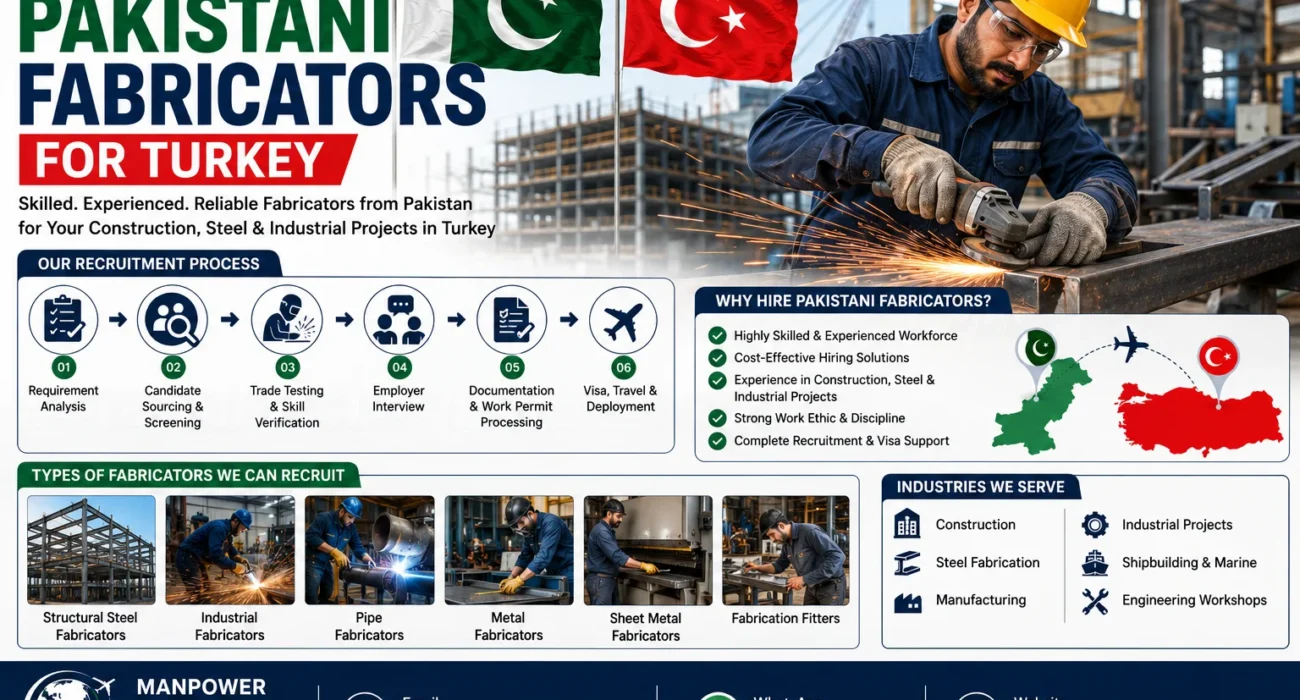
How to Hire Pakistani Fabricators for Turkey: Complete Guide
Turkey’s construction, manufacturing, steel fabrication, engineering, infrastructure, and industrial sectors often require experienced technical workers who can work efficiently with metal, steel structures, machinery, and fabricated components.
For Turkish companies looking to hire Pakistani fabricators for Turkey, recruiting internationally can provide access to a wider pool of skilled workers. Pakistan has experienced fabricators who have worked on construction sites, steel structures, industrial projects, workshops, machinery, and fabrication facilities.
However, successful overseas recruitment is about more than collecting CVs. Turkish employers need to identify the right trade, verify experience, assess practical skills, conduct interviews, prepare employment documentation, and complete the applicable work permit and deployment procedures.
This guide explains how Turkish companies can hire Pakistani fabricators, what to include in a manpower requirement, how fabricators can be tested, and how a Pakistani manpower recruitment agency can support the process.
Why Hire Pakistani Fabricators for Turkey?
Fabrication is a practical trade where experience and workmanship can have a direct impact on project quality.
Pakistani fabricators may have experience in:
- Steel fabrication
- Structural steel
- Metal fabrication
- Industrial fabrication
- Pipe fabrication
- Machinery fabrication
- Sheet metal work
- Workshop fabrication
- Construction fabrication
- Cutting and fitting
- Measuring and marking
- Grinding and finishing
- Assembly and installation
The important thing is to match the worker’s actual experience with the Turkish employer’s requirements.
For example, a fabricator experienced in structural steel may be an excellent candidate for a construction project but may not have the specialized experience required for machinery or precision fabrication.
What Does a Fabricator Do?
A fabricator generally works with metal or other materials to produce components, structures, frames, or assemblies according to drawings, measurements, and project specifications.
Depending on the position, a fabricator may be responsible for:
- Reading drawings
- Measuring materials
- Marking cutting lines
- Cutting metal
- Drilling
- Grinding
- Fitting components
- Aligning parts
- Welding preparation
- Assembly
- Finishing
- Quality checking
- Following workplace safety procedures
The exact responsibilities depend on the industry and employer.
Types of Pakistani Fabricators Turkish Companies Can Hire
Structural Steel Fabricators
Structural steel fabricators can work on:
- Steel frames
- Columns
- Beams
- Platforms
- Industrial structures
- Warehouses
- Construction projects
Employers should look for candidates who have experience working with structural drawings, measurements, cutting, fitting, alignment, and assembly.
Industrial Fabricators
Industrial fabricators may work in factories, plants, workshops, and industrial facilities.
Their experience can include fabrication of:
- Industrial structures
- Equipment
- Frames
- Platforms
- Machinery components
- Tanks
- Supports
Pipe Fabricators
Pipe fabrication is more specialized and can involve cutting, fitting, alignment, and preparation of piping components.
Turkish employers should clearly state the type of pipe work and materials involved when requesting candidates.
Metal Fabricators
Metal fabricators may work with different metals and produce components for construction, manufacturing, workshops, and industrial applications.
Sheet Metal Fabricators
Sheet metal workers can be involved in cutting, forming, assembling, and finishing metal sheets for different applications.
Fabrication Fitters
Some employers require workers who can combine fabrication and fitting skills.
These workers may need to understand drawings, take accurate measurements, prepare materials, fit components, and ensure proper alignment before welding or final assembly.
How to Hire Pakistani Fabricators for Turkey
A successful recruitment process should start with a clear job requirement.
The following steps can help Turkish employers organize the process.
1. Prepare a Detailed Fabricator Job Requirement
The first step is to prepare a clear manpower requirement.
Turkish employers should provide information such as:
- Job title
- Number of fabricators
- Required experience
- Fabrication specialization
- Materials used
- Project type
- Technical skills
- Qualification requirements
- Trade certificates
- Salary
- Working hours
- Overtime
- Accommodation
- Transportation
- Contract duration
- Project location
- Expected joining date
For example:
30 Structural Steel Fabricators – minimum 3 years of experience – experience reading fabrication drawings – steel construction project in Türkiye – accommodation provided.
This gives the recruitment agency a much clearer understanding of the workers required.
A vague requirement such as “We need fabricators” can result in candidates with very different backgrounds.
2. Contact a Pakistani Manpower Recruitment Agency
After preparing the requirement, the Turkish employer can approach a Pakistani overseas recruitment agency.
A professional recruitment partner can assist with:
- Candidate sourcing
- CV screening
- Experience verification
- Shortlisting
- Employer interviews
- Trade testing
- Skill verification
- Documentation coordination
- Visa support
- Work permit coordination
- Travel arrangements
- Deployment
Manpower Agency Pakistan’s recruitment services include overseas manpower recruitment, candidate sourcing and screening, bulk manpower recruitment, trade testing and skill verification, and visa/documentation support.
For Turkish companies recruiting several fabricators at once, using one recruitment partner can make the process easier to manage.
3. Source Pakistani Fabricators
Once the job order has been received, candidates can be sourced according to the employer’s requirements.
Candidates should be considered based on:
- Fabrication experience
- Years of experience
- Previous projects
- Materials worked with
- Technical skills
- Drawing-reading ability
- Qualifications
- Trade certificates
- Previous employers
- Availability
For example, if a Turkish company needs structural steel fabricators, the recruitment team should prioritize workers with relevant structural steel experience.
The objective should be quality matching rather than sending the largest number of CVs.
4. Screen Candidates Before the Employer Interview
Candidate screening is an important stage of international recruitment.
Before presenting candidates to a Turkish employer, their profiles can be reviewed for:
- Previous employment
- Years of experience
- Fabrication specialization
- Technical skills
- Qualifications
- Trade certificates
- Previous projects
- Job responsibilities
- Relevant documents
A recruitment agency’s candidate sourcing and screening service can help employers receive candidates who have been reviewed against their specific requirements.
For technical workers such as fabricators, screening should focus particularly on hands-on experience.
5. Verify the Fabricator’s Practical Experience
A CV may say that someone has five or ten years of fabrication experience, but employers should look deeper.
Ask:
What type of fabrication have they performed?
For example:
- Structural steel
- Industrial fabrication
- Pipe fabrication
- Sheet metal
- Machinery
- Workshop fabrication
What materials have they worked with?
For example:
- Mild steel
- Carbon steel
- Stainless steel
- Aluminum
- Other metals
Can they read drawings?
This can be particularly important for structural and industrial fabrication.
Can they perform accurate measurements?
Fabrication often requires accurate measuring and marking.
Can they cut and fit components?
These are fundamental practical skills for many fabrication positions.
Have they worked with welders?
Fabricators and welders frequently work together, so understanding the fabrication and welding sequence can be valuable.
6. Conduct a Practical Fabricator Trade Test
For a technical position such as fabrication, a practical assessment can provide valuable information that a CV cannot.
Depending on the employer’s requirements, a practical test can assess:
- Measuring
- Marking
- Cutting
- Grinding
- Drilling
- Fitting
- Alignment
- Assembly
- Drawing interpretation
- Material identification
- Tool handling
- Workplace safety
The test should reflect the actual job as closely as possible.
Pakistan’s Emigration Rules provide for selected overseas workers to demonstrate proficiency in the relevant trade according to the foreign employer’s requirements, with trade testing arranged where applicable through an approved trade test centre or approved venue.
For this reason, practical testing can be particularly useful when Turkish companies need workers for specialized fabrication positions.
7. Turkish Employer Interviews the Shortlisted Fabricators
After screening and practical testing, suitable candidates can be presented to the Turkish employer.
Interviews can be conducted through:
- Video calls
- Online meetings
- Telephone
- Face-to-face interviews
- Employer representatives in Pakistan
The employer can ask candidates about:
- Previous fabrication projects
- Types of materials used
- Drawing-reading experience
- Cutting and fitting skills
- Previous industrial experience
- Construction experience
- Safety practices
- Working environment
- Previous international employment
- Availability
The Turkish employer should make the final hiring decision.
8. Finalize Salary and Employment Conditions
Once the Turkish employer selects the fabricators, the employment conditions should be clearly communicated.
These may include:
- Salary
- Working hours
- Overtime
- Accommodation
- Food or allowance
- Transportation
- Contract period
- Work location
- Benefits
- Joining date
Clear communication before deployment can help avoid misunderstandings later.
The Turkish Ministry of Labour lists an employment contract signed by the employer and foreign worker among the documents used in the work permit evaluation process.
Turkey Work Permit for Pakistani Fabricators
A Pakistani fabricator who will work legally in Türkiye generally needs the appropriate work authorization.
The Turkish Ministry of Labour explains that foreign workers applying from abroad follow a two-stage process.
First, the foreign worker applies in person for a work permit at the relevant Turkish embassy or consulate in the country where they are a citizen or legally resident. The applicant receives a 16-digit reference number.
The worker then provides this reference number to the Turkish employer, who submits the employer-side work permit application through Türkiye’s electronic system.
Turkish employers should always check the latest official requirements before starting a recruitment project because procedures and requirements can change.
How Long Does the Turkish Work Permit Process Take?
The Turkish Ministry of Labour states that duly completed work permit applications are evaluated within 30 days, provided the required information and documents are complete.
However, the 30-day evaluation period should not be confused with the complete recruitment timeline.
Before the work permit application, the employer may need to complete:
- Job requirement
- Candidate sourcing
- Screening
- Trade testing
- Employer interviews
- Candidate selection
- Employment contract
Afterward, there may be:
- Work permit procedures
- Visa procedures
- Travel arrangements
- Pre-departure coordination
- Deployment
Turkish companies should therefore begin recruitment well before the workers are needed on the project.
Documents for Pakistani Fabricators
The exact documentation depends on the worker, employer, occupation, and application.
Depending on the circumstances, documents may include:
- Passport
- Employment contract
- Experience certificates
- Trade certificates
- Educational certificates
- Photographs
- Medical documents
- Police clearance
- Work permit documentation
- Visa documents
The Turkish Ministry provides official information regarding documents used in work permit evaluation, including an employment contract and passport copy.
Employers should check the latest official requirements before submitting applications.
For recruitment coordination from Pakistan, visa and documentation support can assist with areas such as work permit processing, visa preparation, certificate attestation, medical examination coordination, and travel arrangements.
Bulk Recruitment of Pakistani Fabricators for Turkey
Large construction and industrial projects may require many fabricators at the same time.
For example:
| Position | Number Required |
|---|---|
| Structural Steel Fabricators | 30 |
| Industrial Fabricators | 15 |
| Pipe Fabricators | 10 |
| Fabrication Fitters | 15 |
| Sheet Metal Fabricators | 10 |
| Total | 80 |
Instead of recruiting each position separately, a Turkish employer can provide one complete manpower requirement.
Bulk manpower recruitment is designed for larger workforce requirements, including construction, factory, and industrial projects. The service describes support for large teams, group documentation, and travel arrangements.
This can make large-scale recruitment more organized.
What Should Turkish Employers Look for in a Pakistani Fabricator?
1. Relevant Fabrication Experience
The worker should have experience that matches the employer’s actual project.
2. Drawing-Reading Ability
For many structural and industrial roles, understanding drawings can be an important skill.
3. Measuring and Marking
Accuracy is essential when preparing fabricated components.
4. Cutting and Fitting Skills
The worker should understand how components are prepared and fitted before final assembly or welding.
5. Practical Tool Skills
Employers can assess the worker’s ability to safely use relevant fabrication tools.
6. Material Knowledge
Experience working with the materials used in the employer’s project can be valuable.
7. Safety Awareness
Fabrication involves cutting equipment, grinders, lifting operations, welding environments, and other workplace hazards. Workers should understand appropriate safety procedures.
Industries That Can Hire Pakistani Fabricators in Turkey
Pakistani fabricators may be suitable for several industries depending on their skills and the employer’s requirements.
Construction
Fabricators can support structural steel and building construction projects.
Steel Fabrication
Fabricators can work in steel workshops and manufacturing facilities.
Manufacturing
Manufacturing companies may require workers to fabricate frames, components, supports, and machinery parts.
Industrial Projects
Industrial facilities can require fabricators for structures, platforms, equipment supports, and other components.
Shipbuilding and Marine
Specialized fabrication workers may be required for certain shipbuilding and marine projects, depending on qualifications and experience.
Engineering Workshops
Workshops may require fabricators for custom metalwork and machinery components.
Why Use a Pakistani Manpower Agency to Recruit Fabricators?
International recruitment can become complicated when an employer needs many technical workers.
A professional Pakistani manpower recruitment agency can assist with:
Candidate Sourcing
Find candidates according to the required fabrication specialization.
Screening
Review experience, qualifications, and documents.
Trade Testing
Arrange practical assessments where appropriate.
Employer Interviews
Coordinate interviews between Turkish companies and Pakistani candidates.
Documentation
Support recruitment-related paperwork.
Deployment
Coordinate pre-departure and travel arrangements.
Manpower Agency Pakistan states that its recruitment services cover candidate sourcing, screening, trade testing, bulk manpower recruitment, and visa/documentation support.
Pakistan’s Overseas Recruitment Requirements
Turkish companies recruiting Pakistani fabricators should also consider Pakistan’s overseas employment regulations.
The Bureau of Emigration & Overseas Employment (BEOE) provides the regulatory framework for overseas employment and publishes information regarding Overseas Employment Promoters.
The BEOE advises employers and workers not to use recruitment agencies that are not licensed by the Bureau, and recommends dealing with licensed agencies and valid job orders.
Employers can also check the BEOE’s official list of Overseas Employment Promoters when conducting due diligence.
This is an important step when selecting a recruitment partner in Pakistan.
How Much Does It Cost to Hire Pakistani Fabricators for Turkey?
There is no single fixed recruitment cost.
The overall cost can depend on:
- Number of fabricators
- Type of fabrication
- Experience level
- Candidate sourcing
- Trade testing
- Documentation
- Work permit procedures
- Visa-related expenses
- Medical requirements
- Travel
- Accommodation
- Other employer benefits
Turkish employers should request a clear cost breakdown before starting recruitment.
For technical workers, the cheapest recruitment option may not always provide the best results. Candidate quality, practical skills, experience, and reliability can have a significant impact on project performance.
How Long Does It Take to Recruit Pakistani Fabricators?
The timeline depends on the size and complexity of the recruitment requirement.
Recruiting five fabricators is different from recruiting 100 workers across several fabrication categories.
The process may include:
Job Requirement → Candidate Sourcing → Screening → Trade Testing → Employer Interview → Selection → Documentation → Work Permit → Visa → Travel → Deployment
Factors affecting the timeline include:
- Number of vacancies
- Candidate availability
- Required experience
- Testing requirements
- Employer interview schedule
- Candidate selection
- Documentation
- Work permit procedures
- Visa procedures
- Travel arrangements
Starting early gives Turkish employers more time to identify candidates who genuinely match their requirements.
Example: Turkish Company Hiring 50 Pakistani Fabricators
Imagine a Turkish steel construction company needs 50 fabricators.
Its requirement could be:
| Fabricator Category | Number |
|---|---|
| Structural Steel Fabricators | 20 |
| Industrial Fabricators | 10 |
| Pipe Fabricators | 5 |
| Fabrication Fitters | 10 |
| Sheet Metal Fabricators | 5 |
| Total | 50 |
The recruitment process could then follow these stages:
Stage 1 — Job Order
The Turkish company provides detailed requirements.
Stage 2 — Candidate Sourcing
The Pakistani recruitment agency searches for suitable fabricators.
Stage 3 — Screening
Candidates are reviewed according to experience, skills, and documents.
Stage 4 — Practical Testing
Suitable candidates complete trade tests where applicable.
Stage 5 — Employer Interviews
The Turkish company interviews shortlisted candidates.
Stage 6 — Selection
The employer confirms the final workers.
Stage 7 — Documentation
Employment and recruitment documentation is prepared.
Stage 8 — Work Permit
The employer and workers follow the applicable Turkish work permit process.
Stage 9 — Visa and Travel
Workers complete the applicable visa and travel procedures.
Stage 10 — Deployment
Selected fabricators travel to Türkiye and join the employer.
Common Mistakes When Hiring Fabricators from Pakistan
Hiring Based Only on CVs
A CV can describe experience but cannot always demonstrate practical fabrication skills.
Skipping Practical Testing
For technical workers, practical assessment can provide valuable information about actual ability.
Sending an Unclear Job Description
The employer should clearly state the fabrication type, materials, experience, salary, location, and working conditions.
Waiting Until the Last Minute
International recruitment requires time for sourcing, testing, interviews, documentation, work permits, visas, and travel.
Changing Employment Conditions
Salary, accommodation, working hours, and other major terms should be clearly communicated before final selection.
Using Unauthorized Recruitment Channels
Employers should verify the recruitment partner and use appropriate legal recruitment channels.
Selecting Only on Price
The lowest recruitment cost does not necessarily produce the best workforce.
How to Choose the Right Pakistani Recruitment Agency
Before starting a recruitment project, Turkish companies should consider the following.
Overseas Recruitment Experience
Does the agency understand international manpower recruitment?
Technical Worker Network
Can it source fabricators according to specialization?
Candidate Screening
How does it verify experience and documents?
Trade Testing
Can practical skill tests be arranged?
Bulk Recruitment
Can it recruit dozens or hundreds of workers if required?
Documentation Support
Can it assist with recruitment-related paperwork?
Compliance
Does it follow the applicable Pakistani overseas recruitment requirements?
Communication
Can it maintain clear communication between the Turkish employer and Pakistani candidates?
The BEOE’s official OEP database can be used to verify the status of recruitment agencies in Pakistan.
Why Choose Manpower Agency Pakistan?
Manpower Agency Pakistan provides overseas workforce recruitment services for international employers looking to recruit Pakistani manpower.
Its services include:
- Skilled workers
- Semi-skilled workers
- General workers
- Technical workers
- Construction workers
- Candidate sourcing
- Candidate screening
- Trade testing
- Bulk manpower recruitment
- Visa and documentation support
- Deployment coordination
The company’s recruitment services are designed around the employer’s manpower requirement, including the number of workers, trade, experience, testing requirements, interviews, and deployment schedule.
For Turkish companies, this can be particularly useful when a project requires fabricators together with welders, electricians, steel fixers, carpenters, or other construction and industrial trades.
You can also read our guide on how to hire Pakistani welders for Turkey if your project requires both welding and fabrication workers.
Start Hiring Pakistani Fabricators for Turkey
Hiring Pakistani fabricators can give Turkish companies access to a wider pool of skilled technical workers for construction, steel, manufacturing, engineering, and industrial projects.
The key is proper recruitment.
Start with a detailed manpower requirement. Define the exact fabrication skills you need. Source candidates according to those requirements, verify their experience, arrange practical testing where appropriate, conduct employer interviews, finalize employment conditions, and then proceed with the applicable work permit and deployment procedures.
If your company is looking to hire Pakistani fabricators for Turkey, Manpower Agency Pakistan can help organize the recruitment process according to your workforce requirements.
Email: info@manpoweragencypakistan.com
WhatsApp: +92-333-3680169
Contact Manpower Agency Pakistan and provide your requirements, including the number of fabricators, specialization, experience, salary, project location, accommodation, and expected joining date.
Frequently Asked Questions
Can Turkish companies hire Pakistani fabricators?
Yes. Turkish companies can employ Pakistani workers subject to the applicable Turkish work authorization, employment, immigration, and Pakistani overseas-employment requirements.
What types of Pakistani fabricators can be recruited for Turkey?
Depending on the project, Turkish companies may recruit structural steel fabricators, industrial fabricators, pipe fabricators, metal fabricators, sheet metal workers, and fabrication fitters.
Do Pakistani fabricators need a Turkish work permit?
Foreign workers generally need the appropriate Turkish work permit or applicable exemption before starting employment in Türkiye. The Turkish Ministry provides the applicable work permit procedures.
Can Turkish companies conduct practical tests for Pakistani fabricators?
Yes. Practical trade testing can be arranged where appropriate, allowing employers to assess skills such as measuring, cutting, fitting, grinding, assembly, and drawing interpretation.
Can Turkish companies recruit fabricators in bulk from Pakistan?
Yes. Large requirements can be organized according to trade, specialization, experience, practical testing, employer interviews, and deployment schedules.
How can I start hiring Pakistani fabricators for Turkey?
Prepare a detailed manpower requirement and send it to a suitable Pakistani recruitment agency. Include the number of workers, fabrication specialization, experience, salary, project location, working conditions, accommodation, and expected joining date.
Conclusion
For Turkish construction, steel, manufacturing, engineering, and industrial companies, hiring Pakistani fabricators for Turkey can provide access to experienced technical manpower.
The most important factor is not simply the number of candidates available. It is whether those candidates have the practical skills and experience required for the project.
A structured recruitment process—covering job requirements, sourcing, screening, practical testing, employer interviews, documentation, work permits, and deployment—can help Turkish companies recruit more effectively.
If your company needs skilled fabricators from Pakistan, Manpower Agency Pakistan can help you build a recruitment process around your specific manpower requirements.
Email: info@manpoweragencypakistan.com
WhatsApp: +92-333-3680169