


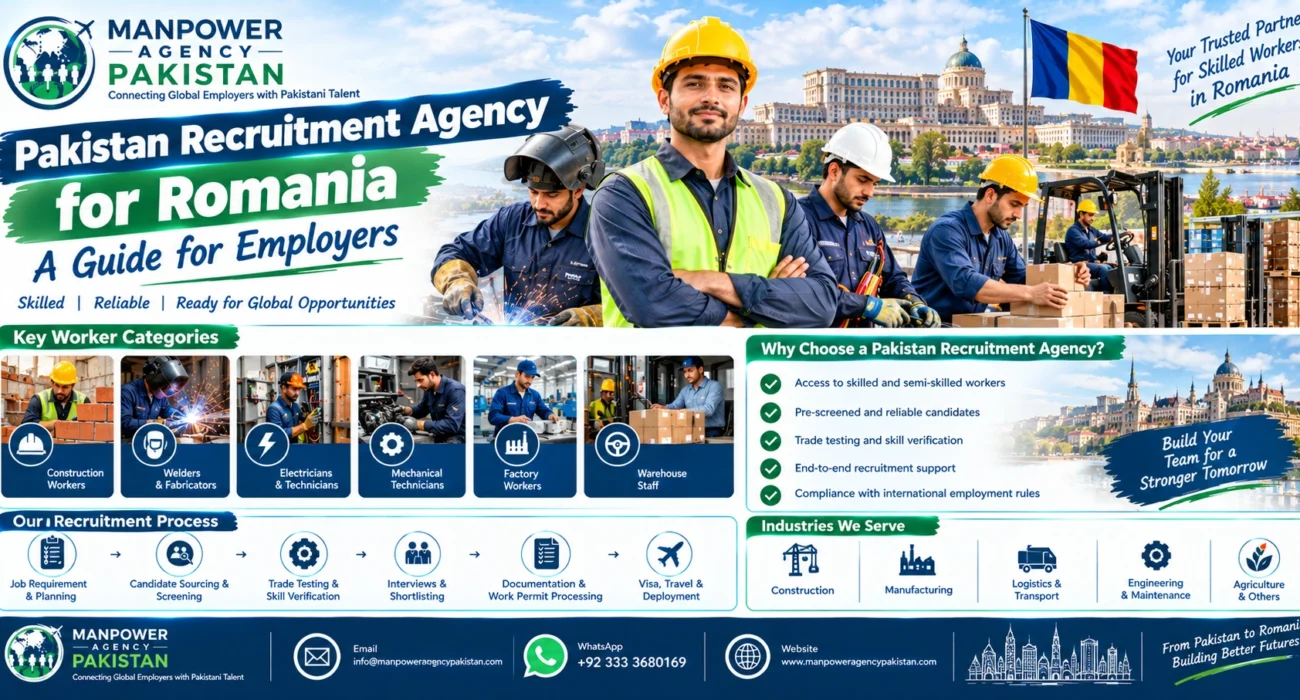
Romanian companies across construction, manufacturing, logistics, warehousing, and technical industries may need reliable workers to support their operations. When local recruitment does not meet workforce requirements, employers may consider hiring qualified candidates from abroad, including Pakistan.
Working with a Pakistan recruitment agency for Romania can help employers identify suitable candidates, assess practical skills, coordinate interviews, and prepare recruitment documentation. However, successful overseas recruitment requires more than finding workers. Employers must also confirm the applicable Romanian employment procedures, contractual requirements, and immigration rules before making hiring commitments.
This guide explains how Romanian employers can approach recruitment from Pakistan, what to consider when selecting a recruitment partner, and how to build a clear, compliant hiring process.
Why Romanian Employers May Consider Pakistani Workers
Pakistan has a large workforce with experience across construction, industrial production, transport, maintenance, and technical trades. Depending on the employer’s requirements, Pakistani candidates may be suitable for a range of positions.
The most important consideration is not nationality alone. Employers should assess each candidate according to qualifications, relevant experience, practical ability, communication skills, and suitability for the specific job.
Industries that may consider Pakistani candidates include:
- Construction: Masons, shuttering carpenters, steel fixers, electricians, plumbers, welders, and general construction workers.
- Manufacturing: Machine operators, production workers, fabricators, and industrial maintenance personnel.
- Mechanical and technical services: Mechanical technicians, HVAC technicians, electricians, and maintenance staff.
- Warehousing and logistics: Warehouse workers, forklift operators, loading and unloading staff, and logistics support personnel.
- Transport: Heavy-vehicle and truck drivers, subject to the required driving licences, qualifications, and Romanian recognition or licensing rules.
- Hospitality and support services: Candidates for suitable kitchen, cleaning, facility-support, and other operational positions.
Employers should define the required qualifications and experience before recruitment begins. Certain positions may require formal certificates, trade tests, language ability, or professional authorisation.
What Does a Pakistan Recruitment Agency for Romania Do?
A recruitment agency can help connect Romanian employers with candidates in Pakistan and coordinate the different stages of the selection process.
The precise services depend on the agreement between the employer and recruitment provider, but a structured recruitment project may include the following.
1. Understanding the Employer’s Workforce Requirements
The first step is to prepare a clear job order. It should identify the number of workers required, job titles, duties, experience levels, salary, working hours, contract duration, work location, accommodation arrangements, and other relevant conditions.
Clear requirements help avoid unsuitable applications and reduce misunderstandings later in the process.
2. Sourcing Suitable Candidates
After understanding the vacancy, the recruitment team can search for candidates whose experience and qualifications match the employer’s needs.
For example, a Romanian construction contractor may require experienced shuttering carpenters and steel fixers, while a manufacturing company may need welders, fabricators, machine operators, or mechanical technicians.
Employers can learn more about overseas manpower recruitment services and skilled, semi-skilled, and unskilled workforce recruitment.
3. Screening CVs and Verifying Experience
A candidate’s CV is only the starting point. Employers should verify employment history, relevant qualifications, references where appropriate, and the candidate’s understanding of the proposed role.
For technical and industrial positions, practical assessments can help establish whether candidates have the skills needed for the job.
Learn more about candidate sourcing and screening and trade testing and skill verification.
4. Arranging Interviews and Trade Tests
Employers can conduct interviews online or arrange practical assessments for shortlisted candidates. Trade tests may be particularly useful for welders, electricians, mechanics, fabricators, carpenters, and other skilled workers.
The assessment criteria should reflect the actual work involved. For example, a welding position may require testing a particular welding process, while a mechanical technician role may require fault diagnosis and maintenance knowledge.
5. Coordinating Recruitment Documentation
Once candidates are selected, the employer and recruitment partners can coordinate the documents required for the employment process.
Depending on the job and applicable rules, these may include identity documents, CVs, qualifications, experience certificates, employment contracts, and other supporting records.
Documentation must be genuine and consistent with the actual job offer. Employers should not assume that candidate selection alone authorises a person to work in Romania.
How Romanian Employers Can Recruit Workers from Pakistan
A practical recruitment process begins with a defined workforce requirement and continues through selection, legal checks, and deployment.
Step 1: Define the Vacancy
Prepare a written job description for every position. Include the number of vacancies, required skills, experience, salary, working schedule, location, accommodation arrangements, and contract duration.
Where several positions are involved, organise the requirements by trade or department.
Step 2: Choose a Suitable Recruitment Partner
Look for a recruitment provider that can explain its candidate-sourcing process, screening methods, documentation responsibilities, service fees, and expected timelines.
Before signing an agreement, clarify who will handle each stage of recruitment and which party is responsible for each legal or administrative requirement. Verify the provider’s applicable licence and authorisation where required.
Employers may review Manpower Agency Pakistan’s recruitment services to understand the services offered and contact the agency to discuss a workforce requirement.
Step 3: Shortlist and Assess Candidates
Review the CVs received and compare candidates against the job specifications. Conduct interviews, check relevant credentials, and use practical tests where necessary.
For bulk recruitment, employers should establish consistent assessment standards so candidates are evaluated fairly against the same requirements.
Step 4: Confirm Employment Terms
Before final selection, confirm the employment terms in writing. The offer and employment contract should clearly explain salary, working hours, overtime arrangements where applicable, leave, accommodation if provided, insurance or other required benefits, and the conditions of employment.
The terms should comply with Romanian labour law and applicable contractual requirements.
Step 5: Verify Romanian Work-Authorisation Procedures
This is a critical stage. Romanian employers must confirm the rules applicable to their company, the type of employment, and the nationality and circumstances of each worker.
The Romanian Government’s official WorkinRomania platform provides information about foreign-worker recruitment and the relevant administrative procedures. The European Commission’s EU Immigration Portal guidance for employed workers in Romania also explains work-authorisation, visa, and residence requirements.
Because Romania’s procedures have changed in 2026 and the official platform has published a notice concerning suspended workflows, employers should check the latest official announcements and obtain case-specific advice before submitting applications or promising a deployment date.
Step 6: Coordinate Departure and Onboarding
Workers should travel only after the required approvals and documents have been obtained. Before departure, ensure that candidates understand their job duties, contract terms, travel arrangements, accommodation details, and reporting instructions.
After arrival, the employer should complete the required employment registration and onboarding steps, provide any mandatory workplace training, and explain health and safety procedures.
What Should Employers Check Before Hiring Pakistani Workers?
International recruitment is more effective when employers assess both workforce suitability and compliance.
Consider the following checklist:
- Job requirements: Are the job descriptions and experience criteria clear?
- Candidate quality: Have relevant qualifications, experience, references, and practical skills been checked?
- Employment terms: Are salary, working hours, accommodation, and other conditions documented accurately?
- Recruitment responsibilities: Does the agreement identify who handles sourcing, assessments, documentation, and communication?
- Legal eligibility: Have current Romanian work-authorisation, visa, and residence requirements been verified?
- Professional qualifications: Are regulated roles subject to licensing, recognition, or additional certification requirements?
- Worker protection: Are the employment terms transparent, and are candidates treated fairly throughout the recruitment process?
- Costs and timing: Have all recruitment fees, administrative costs, and realistic timelines been discussed in advance?
Employers should avoid relying on informal assurances about visas or work permits. Immigration decisions are made through the relevant authorities, and requirements can change.
Which Documents May Be Needed?
The documents required depend on the job, the worker’s circumstances, and the current Romanian procedures. Recruitment and employment files may involve:
- Employer registration or authorisation documents, where applicable.
- A formal job offer and employment contract.
- Candidate passport and identity details.
- CVs, qualification certificates, and evidence of relevant work experience.
- Professional licences or other role-specific credentials, where required.
- Work-authorisation, visa, and residence documentation required under the applicable procedure.
- Additional forms or supporting evidence requested by the competent authorities.
This list is a general guide, not a definitive checklist for every case. Romanian employers should confirm the current requirements through official government sources before submitting an application.
For Pakistani overseas-employment procedures, employers and candidates can also consult the Bureau of Emigration & Overseas Employment (BEOE). Its list of Overseas Employment Promoters can help users check relevant licensing information. The Overseas Employment Corporation is another official Pakistani resource for overseas employment.
Why Candidate Screening Matters
Hiring the wrong candidate can lead to delays, additional recruitment expenses, reduced productivity, and disruption to operations. A structured screening process helps employers make decisions based on evidence rather than assumptions.
For skilled positions, employers should consider:
Technical competence: Can the candidate demonstrate the practical skills required for the role?
Relevant experience: Has the candidate performed similar work in a comparable environment?
Safety awareness: Does the candidate understand relevant workplace safety practices and equipment requirements?
Reliability and communication: Can the candidate follow instructions and communicate effectively with supervisors and colleagues?
Document verification: Are the candidate’s identity, qualifications, and employment history consistent and credible?
For large recruitment projects, a documented assessment process can also help employers compare candidates consistently and maintain clear recruitment records.
How Bulk Recruitment Can Help Growing Romanian Businesses
Some employers need several workers for a construction project, factory, warehouse, or operational expansion. In these situations, recruitment should be planned around workforce numbers, skill categories, and required start dates.
A bulk recruitment project may involve preparing separate job specifications, sourcing candidates by trade, scheduling interviews, arranging practical assessments, and maintaining a shared record of candidate progress.
Employers can explore bulk manpower recruitment services when planning larger hiring requirements.
The recruitment schedule should allow sufficient time for candidate selection, document checks, and all applicable legal procedures. No recruitment provider should guarantee a visa decision or a fixed arrival date before the relevant approvals are confirmed.
Why Consider Manpower Agency Pakistan?
Manpower Agency Pakistan works in overseas recruitment and provides information about its recruitment services through its website. Employers seeking Pakistani candidates can discuss their staffing requirements with the agency to determine whether the requested roles and recruitment arrangements are suitable.
When contacting a recruitment provider, Romanian employers should be ready to share their job descriptions, number of vacancies, required experience, proposed salary, work location, and anticipated hiring schedule. This information helps establish the scope of the recruitment project and the next steps.
You can visit Manpower Agency Pakistan to learn more about the agency and its services, or use the contact page to discuss your requirements.
Frequently Asked Questions
Can Romanian companies recruit workers from Pakistan?
Romanian companies may recruit eligible non-EU nationals, subject to the applicable Romanian employment, immigration, and authorisation rules. Employers should verify the current procedure before beginning recruitment.
Which Pakistani workers can Romanian employers recruit?
Depending on the vacancy and the candidate’s qualifications, employers may consider construction workers, welders, electricians, mechanics, fabricators, factory workers, warehouse staff, and other suitable professionals. Each candidate must meet the requirements of the specific job.
How long does recruitment from Pakistan to Romania take?
There is no single timeline for every recruitment project. The duration depends on sourcing, interviews, document verification, employer readiness, and the applicable authorisation and visa procedures. Employers should confirm current processing conditions before setting a start date.
Does selecting a candidate guarantee a Romanian work visa?
No. Candidate selection does not guarantee work authorisation, a visa, or permission to reside and work in Romania. The relevant authorities decide applications under the rules in force.
How can employers verify a Pakistani recruitment provider?
Employers should review the provider’s experience, references, service agreement, and relevant licensing or authorisation. Pakistani overseas-employment licensing information can be checked through the official BEOE website. Employers should also verify any Romanian authorisation required for the particular recruitment arrangement.
What information should an employer provide when requesting workers?
Provide the job title, number of vacancies, duties, experience and skill requirements, salary, working hours, contract duration, work location, accommodation details, and desired recruitment schedule. Also explain any language, certification, or licensing requirements.
Conclusion
Recruiting from Pakistan can give Romanian employers access to candidates with a range of construction, industrial, technical, and operational skills. The best results come from clear job specifications, careful candidate screening, transparent employment terms, and a recruitment process that follows the applicable legal requirements.
A reliable recruitment arrangement should make responsibilities clear and keep employers informed at every stage. Before moving forward, verify Romania’s current foreign-worker procedures, confirm the necessary authorisations, and ensure that the proposed employment conditions are documented properly.
If your company is considering recruitment from Pakistan, visit Manpower Agency Pakistan or contact the team to discuss your workforce requirements.