


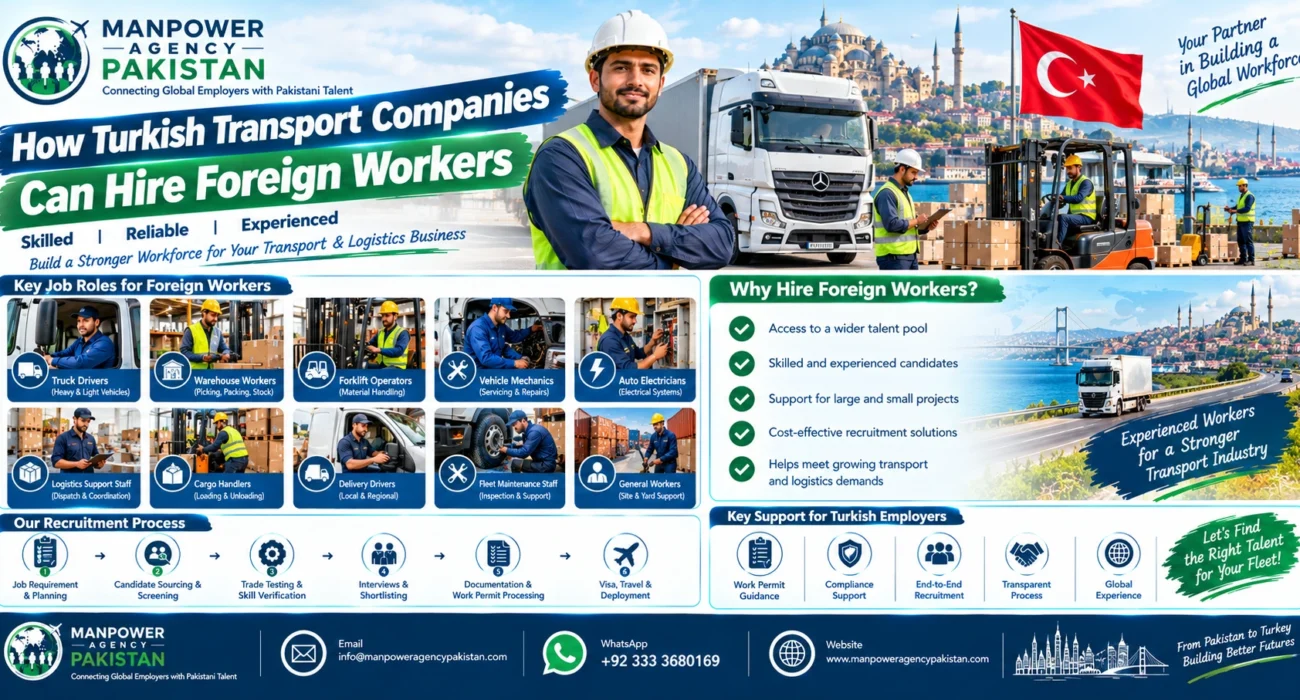
Turkey’s transport and logistics industry depends on reliable drivers, warehouse staff, cargo handlers, fleet maintenance teams, and other skilled employees. As transport companies expand their operations, they may need to look beyond the local labour market to find workers with the right experience and skills.
For employers planning to hire foreign workers in Turkey, international recruitment can provide access to a broader talent pool. With proper candidate screening, clear employment terms, and compliance with Turkish work permit requirements, transport businesses can build a workforce that supports their daily operations and long-term growth.
Manpower Agency Pakistan helps employers explore overseas recruitment solutions for suitable Pakistani candidates across transport, logistics, warehousing, and other workforce categories.
Why Turkish Transport Companies May Need Foreign Workers
Transport companies face different staffing requirements depending on their fleet size, routes, warehouse capacity, and customer commitments. A shortage of suitable employees can make it harder to maintain schedules, manage cargo, and keep vehicles operating efficiently.
International recruitment may help companies address specific staffing needs, particularly when they require workers with relevant practical experience.
Common reasons to consider foreign recruitment include:
- Growing transport operations: Additional drivers, loading teams, and warehouse employees may be required as business volumes increase.
- Specialised skills: Some employers need experienced mechanics, vehicle electricians, or heavy vehicle technicians.
- Warehouse expansion: Distribution centres may require forklift operators, inventory assistants, pickers, and packers.
- Fleet maintenance: Skilled technicians can support inspections, repairs, servicing, and equipment maintenance.
- Project-based requirements: Logistics contracts and large cargo movements may create temporary or long-term staffing needs.
Before beginning recruitment, employers should identify the positions they need to fill and determine whether foreign recruitment is appropriate for each role.
Which Foreign Workers Can Turkish Transport Companies Recruit?
The right candidates depend on the employer’s business model and the legal requirements applicable to each occupation.
1. Heavy Truck and Trailer Drivers
Long-distance transport businesses may require experienced drivers to move goods between cities, industrial zones, warehouses, and distribution centres.
Employers should verify driving experience, licence categories, road-safety knowledge, and the candidate’s eligibility to obtain any Turkish licence or professional authorisation required for the intended work.
2. Light Vehicle and Delivery Drivers
Delivery companies and logistics providers may need drivers for local distribution, commercial deliveries, and warehouse transfers. Candidates should understand vehicle safety, route planning, delivery documentation, and customer service.
3. Heavy Vehicle Mechanics
Fleet operators depend on properly maintained vehicles. Experienced diesel mechanics and heavy vehicle technicians can help with servicing, fault diagnosis, preventive maintenance, and repairs.
Practical assessments are useful for checking whether candidates can work safely with the types of vehicles in the employer’s fleet.
4. Auto Electricians and Fleet Maintenance Technicians
Modern commercial vehicles use electrical and electronic systems that require specialised troubleshooting. Employers may seek auto electricians, diagnostic technicians, tyre technicians, and other maintenance personnel.
5. Warehouse and Cargo Handling Workers
Transport and freight companies also need employees who can manage the movement of goods through warehouses and distribution centres.
Potential positions include:
- Warehouse workers and assistants
- Forklift operators
- Cargo handlers and loaders
- Packing and sorting staff
- Inventory assistants
- Dispatch and loading coordinators
Forklift operators and other equipment users should have the necessary training, qualifications, and authorisations for the equipment and workplace.
6. Logistics and Operations Support Staff
Depending on the business, employers may also require fleet coordinators, dispatch assistants, shipment documentation staff, and inventory controllers.
These roles can require communication skills, computer literacy, familiarity with logistics systems, and the ability to coordinate deliveries and warehouse activities.
How to Hire Foreign Workers in Turkey: Step-by-Step
A structured recruitment process helps Turkish transport companies identify suitable candidates and prepare the required employment documentation.
Step 1: Define Your Staffing Requirements
Begin by preparing a clear job description for every vacancy. Specify the job title, number of employees, work location, duties, working hours, required experience, salary, and employment duration.
For driving positions, identify the vehicle type, route requirements, licence category, and any professional qualifications that may be necessary.
Clear requirements help a recruitment partner source candidates who match the actual job rather than sending unsuitable CVs.
Step 2: Choose a Suitable Overseas Recruitment Partner
Companies recruiting internationally may work with a recruitment agency that understands overseas candidate sourcing, screening, documentation, and deployment procedures.
Manpower Agency Pakistan provides information about its overseas manpower recruitment services for employers seeking candidates from Pakistan.
Transport companies can also review its transport and logistics recruitment services to discuss their staffing requirements.
When selecting a recruitment partner, employers should confirm its relevant experience, recruitment authorisations, screening procedures, service terms, and ability to support the required recruitment volume.
Step 3: Source and Screen Suitable Candidates
Candidate screening should focus on the requirements of the specific vacancy.
Depending on the role, the recruitment process may include:
- Reviewing CVs and employment history
- Checking identity and passport details
- Verifying relevant certificates and licences
- Confirming previous transport or warehouse experience
- Assessing communication and workplace safety knowledge
- Checking references where appropriate
For driving and technical roles, document checks should be supported by practical assessments wherever possible.
Employers can learn more about candidate sourcing and screening and how structured selection can help them identify suitable workers.
Step 4: Conduct Interviews and Practical Tests
Interviews allow employers to assess a candidate’s experience, attitude, communication, and understanding of the job.
For drivers, an employer may review vehicle knowledge, defensive driving experience, road-safety awareness, and route familiarity. Any road test must be conducted lawfully and safely.
For mechanics, technicians, and warehouse equipment operators, a trade test can help verify practical ability.
Manpower Agency Pakistan offers information about its trade testing and skill verification services for employers who need to evaluate candidates before selection.
Step 5: Confirm Employment Terms and Turkish Work Permit Requirements
This is one of the most important stages of international recruitment.
Foreign nationals generally need a valid work permit or a legally applicable work permit exemption before starting employment in Turkey. The correct process depends on the worker’s circumstances and the applicable rules.
Turkey’s Ministry of Labour and Social Security explains the official requirements through its work permit application guidelines. Employers can also consult the government’s Foreign National Employment portal for application information.
For overseas candidates, the process generally involves the worker and employer completing their respective steps through the relevant Turkish foreign representative office and the Ministry’s work permit system. The exact sequence and documents should be confirmed for the individual case.
Before submitting an application, the employer should verify:
- The candidate’s eligibility for the intended occupation
- The correct work permit application route
- The employment contract and supporting documents
- Any applicable employer eligibility criteria
- Whether professional licences or additional authorisations are required
- Applicable fees, deadlines, and post-approval obligations
A job offer, recruitment agreement, or visa application should not be treated as a guarantee that a work permit will be approved.
Step 6: Complete Pakistani Overseas Employment Formalities
When recruiting workers from Pakistan, employers and their recruitment partners should also confirm the relevant Pakistani overseas employment requirements.
The Bureau of Emigration and Overseas Employment (BEOE) provides official information about Pakistan’s overseas employment framework. Employers can use its resources to check applicable procedures and recruitment-related requirements.
Depending on the recruitment arrangement, the process may involve employment documentation, candidate clearance, medical examinations where required, and other applicable formalities before departure.
Manpower Agency Pakistan can discuss recruitment coordination and visa documentation support as part of an employer’s overseas hiring plan.
Step 7: Arrange Travel, Joining, and Workplace Orientation
Once the necessary approvals and formalities are complete, the employer and recruitment partner can coordinate travel and joining arrangements.
Before the employee begins work, the company should provide a clear orientation covering:
- Job responsibilities and reporting lines
- Workplace health and safety
- Vehicle and equipment procedures
- Working hours and attendance
- Emergency contacts and incident reporting
- Company policies and employment conditions
For drivers and warehouse personnel, site-specific training is especially important because employees may work around moving vehicles, loading equipment, heavy cargo, and busy traffic areas.
Why Consider Recruiting Pakistani Workers for Turkish Transport Companies?
Pakistan is one potential source of overseas workers for employers seeking candidates with relevant practical experience. The suitability of any candidate depends on their qualifications, experience, language ability, legal eligibility, and the requirements of the job.
Depending on the employer’s needs, Pakistani candidates may be considered for positions such as:
| Job category | Experience or skills to assess |
|---|---|
| Heavy vehicle drivers | Driving history, licence eligibility, road safety |
| Delivery drivers | Vehicle handling, navigation, delivery procedures |
| Diesel mechanics | Engine servicing, fault diagnosis, repairs |
| Auto electricians | Electrical troubleshooting and diagnostics |
| Warehouse workers | Loading, packing, stock handling, safety |
| Forklift operators | Equipment experience, training, authorisation |
| Cargo handlers | Safe loading, unloading, cargo protection |
| Fleet maintenance staff | Preventive maintenance and inspection procedures |
These are potential recruitment categories, not a guarantee that every position is open to foreign nationals. Turkish employers should check occupation-specific restrictions, work permit eligibility, and any required local certification before making an offer.
For employers needing different workforce levels, Manpower Agency Pakistan also provides information about skilled, semi-skilled, and unskilled workers.
What Should Turkish Employers Check Before Hiring Foreign Workers?
International recruitment requires planning beyond candidate selection. A good recruitment decision considers the full employment arrangement.
1. Legal eligibility: Confirm that the proposed employee can lawfully work in the intended role and location.
2. Professional qualifications: Check whether the job requires a specific driving licence, vocational certificate, or technical authorisation.
3. Total employment cost: Budget for wages, applicable employer contributions, recruitment costs, permits, travel, accommodation if provided, and onboarding.
4. Contract clarity: Make sure duties, salary, working hours, leave, overtime arrangements, and other conditions are clearly documented in line with applicable law.
5. Workplace safety: Prepare suitable training, personal protective equipment, and safety procedures.
6. Recruitment transparency: Agree on recruitment fees, responsibilities, replacement terms if applicable, and document-handling procedures in writing.
7. Retention and integration: Provide clear supervision, fair working conditions, and practical workplace communication support.
These steps help employers make better-informed recruitment decisions and reduce avoidable delays.
Common Challenges in Foreign Worker Recruitment
Work Permit Delays or Rejections
Applications may take longer or be refused if eligibility requirements are not met or documents are incomplete. Employers should consult official guidance and confirm requirements before committing to a joining date.
Licence Recognition and Professional Authorisation
A foreign driving licence does not automatically establish eligibility to drive every type of commercial vehicle in Turkey. Employers should confirm the relevant licensing, conversion, professional qualification, and authorisation requirements with the competent Turkish authorities.
Language and Communication
Transport work often involves instructions, delivery documents, safety briefings, and communication with customers or dispatch teams. Employers should assess the language skills needed for each position and provide appropriate training.
Mismatch Between Candidate Skills and Job Requirements
A CV alone may not demonstrate practical ability. Interviews, reference checks, and trade tests can help employers assess candidates before making a final selection.
Unexpected Recruitment Costs
International recruitment may involve several separate cost categories. Employers should request a written breakdown and confirm which party is responsible for each expense before the process begins.
How Manpower Agency Pakistan Can Support Turkish Transport Employers
Manpower Agency Pakistan works in overseas recruitment and can discuss workforce requirements with Turkish businesses seeking suitable candidates from Pakistan.
Depending on the agreed scope and job requirements, recruitment support may include:
- Understanding job descriptions and staffing numbers
- Sourcing candidates for specified roles
- Reviewing experience and employment history
- Coordinating interviews and practical assessments
- Supporting recruitment documentation and communication
- Discussing bulk recruitment requirements for larger operations
Companies can explore the company’s recruitment services or submit their requirements through the Manpower Agency Pakistan contact page.
For a more effective initial discussion, employers should share the job titles, number of vacancies, location, expected joining period, salary range, required qualifications, and whether the vacancies are permanent or project-based.
Frequently Asked Questions
1. Can Turkish transport companies hire foreign workers?
Yes, foreign nationals may be employed where they meet the relevant eligibility requirements and obtain a valid work permit or applicable exemption. Employers should confirm the rules for the specific job and candidate before employment begins.
2. Can Turkish companies recruit Pakistani truck drivers?
Pakistani candidates may be considered for driving positions, subject to the employer’s requirements and the applicable Turkish work permit, driving licence, professional qualification, and road-safety rules. Employers should verify eligibility before making a final offer.
3. Which foreign workers are useful for transport and logistics companies?
Depending on their operations, companies may recruit drivers, mechanics, auto electricians, warehouse workers, cargo handlers, forklift operators, and fleet maintenance personnel.
4. What documents may be needed to hire a foreign worker in Turkey?
Requirements vary by application route and individual circumstances. Documents may include a valid passport, employment contract, application information, and other supporting records required by the Turkish authorities. Employers should consult the official work permit guidance for the current list.
5. How can a Turkish company recruit workers from Pakistan?
A company can define its vacancies, work with a suitable overseas recruitment partner, screen and interview candidates, verify qualifications, and complete the applicable Turkish and Pakistani employment formalities before deployment.
6. How long does foreign worker recruitment take?
The timeframe depends on candidate availability, interview and testing arrangements, document preparation, work permit processing, and any licensing or other approvals. Employers should confirm current processing requirements and avoid promising a fixed joining date before approvals are secured.
7. Can a recruitment agency guarantee work permit approval?
A recruitment agency can help coordinate recruitment and documentation within its agreed scope, but the relevant authorities make permit decisions. Employers should be cautious of anyone promising guaranteed approval.
Conclusion
For Turkish transport and logistics companies, international recruitment can be one way to find workers with the skills needed for driving, fleet maintenance, warehousing, and cargo operations. Success depends on defining the right vacancies, verifying candidate experience, checking professional qualifications, and completing all required employment and work permit procedures.
If your company plans to hire foreign workers in Turkey, Manpower Agency Pakistan can discuss recruitment requirements for suitable Pakistani candidates across transport and logistics roles.
Visit Manpower Agency Pakistan to explore recruitment services, or contact the team at info@manpoweragencypakistan.com to discuss your staffing needs.