


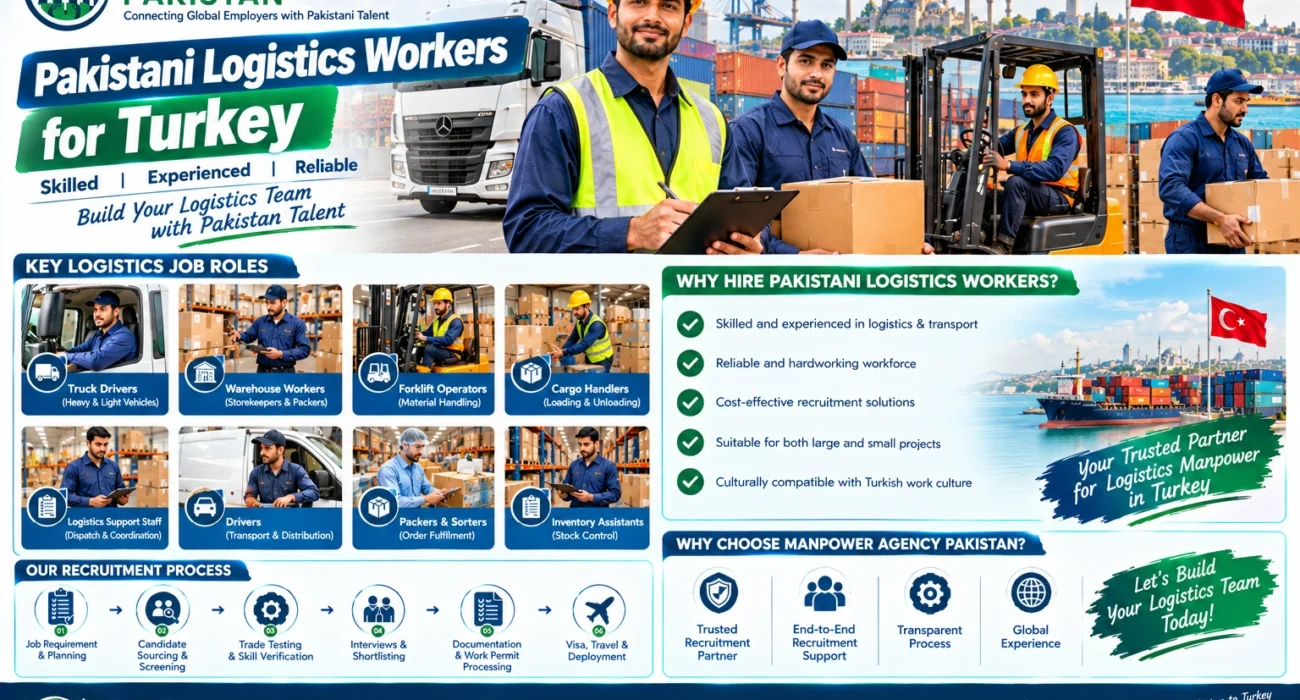
Pakistani logistics workers for Turkey
Turkey’s logistics and transportation sector plays an important role in connecting Europe, Asia, and the Middle East. From freight transportation and distribution centres to warehouses, factories, and international supply chains, companies need reliable workers to keep goods moving efficiently.
For Turkish businesses looking to expand their workforce, Pakistani logistics workers for Turkey may be a recruitment option worth considering. Pakistani candidates with relevant experience in truck driving, warehouse operations, forklift handling, cargo loading, and logistics support can be assessed against an employer’s specific requirements.
At Manpower Agency Pakistan, we support international employers seeking suitable Pakistani candidates for different workforce requirements. This guide explains which logistics workers companies may recruit, how to evaluate candidates, and what employers should consider before hiring workers from Pakistan.
Why Consider Pakistani Logistics Workers for Turkey?
Logistics companies need more than people who can simply move goods. They need employees who understand workplace safety, delivery schedules, equipment handling, inventory procedures, and teamwork.
Recruiting Pakistani workers can help Turkish employers explore a broader candidate pool for suitable positions, provided candidates meet the required skills, experience, language, and legal employment criteria.
1. Truck and Heavy Vehicle Drivers
Transportation companies may need experienced drivers for freight movement, regional deliveries, and long-distance transport. Depending on the vacancy, employers can consider candidates with experience operating heavy trucks, trailers, or other commercial vehicles.
Before hiring, Turkish employers should verify the candidate’s driving history, licence category, professional experience, and eligibility to obtain any required Turkish driving authorisation.
2. Warehouse Workers and Storekeepers
Warehouses and distribution centres require staff who can receive shipments, sort products, prepare orders, maintain stock records, and organise goods for dispatch.
Potential roles include:
- Warehouse assistants
- Storekeepers and inventory assistants
- Order pickers and packers
- Loading and unloading workers
- Dispatch assistants
- Stock control personnel
Candidates should be assessed for accuracy, physical job requirements, safe handling practices, and familiarity with warehouse procedures.
3. Forklift Operators and Material Handlers
Forklift operators help move pallets, raw materials, finished goods, and other loads within warehouses and industrial facilities.
Employers should check practical operating experience, safety awareness, equipment familiarity, and any required licences or certificates. A trade test can help establish whether a candidate can safely perform the specific duties involved.
4. Cargo Handlers and Logistics Assistants
Cargo handling staff support the movement of goods between vehicles, storage areas, loading bays, and distribution facilities. Their duties may include checking packages, arranging shipments, preparing dispatch areas, and following loading instructions.
These roles can be relevant to freight companies, manufacturing businesses, distribution centres, and other employers with regular cargo-handling requirements.
5. Logistics Coordinators and Dispatch Support
Some businesses also require workers with experience in shipment records, delivery coordination, inventory software, and dispatch documentation.
For these positions, employers should assess computer skills, communication ability, attention to detail, and relevant experience with logistics systems. Language requirements should be clearly defined before recruitment begins.
Which Turkish Industries May Need Logistics Workers?
The requirement for logistics staff depends on the employer’s location, business model, shipment volumes, and operational needs.
| Industry | Potential workforce requirements |
|---|---|
| Freight and road transport | Truck drivers, trailer drivers, dispatch assistants |
| Warehousing and distribution | Warehouse workers, storekeepers, order pickers |
| Manufacturing | Material handlers, warehouse assistants, inventory staff |
| Retail and e-commerce | Packers, dispatch workers, stock assistants |
| Industrial facilities | Forklift operators, cargo handlers, loading staff |
| Import and export operations | Logistics assistants, shipment documentation staff |
Companies should prepare a separate job description for each position rather than recruiting under a general “logistics worker” category. This makes it easier to shortlist suitable candidates and establish clear expectations.
How Turkish Companies Can Recruit Pakistani Logistics Workers
A structured recruitment process can reduce hiring mistakes, improve candidate matching, and help employers prepare for deployment.
Step 1: Define Your Manpower Requirements
Start by identifying the exact roles and number of workers required. Specify the job location, duties, working hours, salary, overtime arrangements, accommodation, transport, and other employment conditions.
For example, a freight company hiring 15 truck drivers will need different screening criteria from a warehouse recruiting 30 order pickers and 10 forklift operators.
A clear demand helps the recruitment team find candidates whose experience matches the actual job.
Step 2: Work With a Suitable Recruitment Partner
An overseas recruitment partner can help employers source candidates, review qualifications, coordinate interviews, and organise relevant documentation.
You can explore Manpower Agency Pakistan’s overseas manpower recruitment services to learn more about workforce recruitment support.
For larger requirements, bulk manpower recruitment services may also be relevant when a company needs several workers for a new warehouse, transport contract, or industrial project.
Employers should verify the recruitment provider’s legal authorisation and agree on responsibilities, service fees, timelines, and candidate replacement terms in writing.
Step 3: Screen Candidates for Relevant Experience
Candidate screening should focus on the actual position rather than general work experience.
For truck drivers, review driving history, vehicle types operated, licence details, accident history where lawfully verifiable, and familiarity with road safety.
For warehouse staff, assess stock handling, packing, loading, inventory records, and previous warehouse experience.
For forklift operators, verify equipment experience, safety knowledge, and relevant certification.
Manpower Agency Pakistan provides information about its candidate sourcing and screening services, which can support employers in identifying candidates for further assessment.
Step 4: Arrange Interviews and Practical Assessments
Interviews help employers understand a candidate’s experience, reliability, communication skills, and suitability for the working environment.
Where appropriate, practical assessments can provide additional evidence of ability. Examples include:
- A driving assessment conducted through an appropriate authorised process
- A forklift operation and safety assessment
- A warehouse picking and stock-checking exercise
- A cargo-handling task based on workplace procedures
- A logistics documentation or computer-skills test
Employers can learn more about trade testing and skill verification when evaluating candidates for skill-based roles.
Step 5: Confirm Employment Terms and Turkish Work Authorisation
Before a candidate travels, the employer should confirm the proposed job, salary, contract duration, work location, working conditions, and responsibilities of both parties.
Foreign nationals generally need a valid Turkish work permit or an applicable work-permit exemption before beginning employment. The Turkish Ministry of Labour and Social Security explains the process through its official work permit guidance.
For applications from abroad, the process includes a step by the applicant at the relevant Turkish foreign representative office and a subsequent application by the employer in Türkiye. Requirements can vary according to the applicant and job, so employers should check the current official instructions before proceeding.
Do not assume that a tourist visa or ordinary entry permission authorises employment.
Step 6: Prepare Documents and Coordinate Deployment
Once candidates are selected and the relevant authorisations are progressing, the parties can coordinate the required documents, travel arrangements, and joining dates.
Depending on the role and individual circumstances, documents may include:
- Passport and identity documents
- Employment contract
- Experience letters and relevant certificates
- Driving licence or equipment qualifications, where applicable
- Work permit and visa documentation
- Other documents requested by the competent authorities
For Pakistani recruitment, employers and recruitment partners should also confirm applicable overseas employment formalities through the Bureau of Emigration & Overseas Employment (BEOE). Its official list of Overseas Employment Promoters can help employers verify whether a recruitment promoter is listed.
Step 7: Support Workers After Arrival
Recruitment does not end when a worker arrives. Employers should provide a proper induction, explain workplace safety rules, clarify reporting lines, and ensure workers understand their duties.
For logistics employees, induction may cover warehouse traffic routes, personal protective equipment, vehicle inspection procedures, load limits, emergency contacts, and reporting of damaged goods.
Clear communication and fair employment practices can help workers settle into their roles and support smoother operations.
What Is the Cost of Recruiting Pakistani Logistics Workers for Turkey?
There is no single recruitment cost that applies to every position. The total budget depends on the number of workers, job category, candidate experience, testing requirements, documentation, applicable government fees, travel, and the employment package.
| Cost component | What employers should confirm |
|---|---|
| Recruitment services | Agreed service charges and payment milestones |
| Candidate assessment | Interview, trade test, and verification costs |
| Documentation | Translation, certification, and other required processing |
| Work authorisation | Applicable permit and visa fees |
| Travel | Airfare and agreed transport arrangements |
| Joining support | Accommodation, induction, and initial settlement costs |
Employers should request a written cost breakdown before approving a recruitment campaign. The contract should state which party pays each cost and whether any additional charges may arise.
Do not select a recruitment provider solely on the lowest quoted price. Candidate suitability, transparent procedures, legal compliance, and clear communication are also important.
Challenges Employers Should Consider
Recruiting internationally can offer access to additional candidates, but employers should plan for practical challenges.
Driving licence and qualification requirements: A candidate’s existing licence may not automatically authorise the same vehicle category or professional driving activity in Türkiye. Verify the applicable requirements before making a final selection.
Language and communication: Truck drivers, dispatch staff, and warehouse teams may need to communicate with supervisors, customers, or colleagues in Turkish or another specified language. Set realistic language criteria for each role.
Work permit eligibility: Not every applicant or job automatically qualifies for authorisation. Confirm the employer’s eligibility, the candidate’s documents, and the applicable process with the Turkish authorities.
Workplace safety: Forklift operation, heavy vehicle driving, and cargo handling involve risks. Verify skills and provide role-specific safety training.
Contract clarity: Employment terms should be documented clearly, including wages, working hours, overtime, leave, accommodation if provided, and the responsibilities of each party.
Planning for these points early can help employers avoid unnecessary delays and improve recruitment outcomes.
Why Choose Manpower Agency Pakistan?
Manpower Agency Pakistan supports employers seeking Pakistani workers for overseas employment opportunities across different industries.
Depending on the job requirement, recruitment support may include candidate sourcing, initial screening, coordination of interviews, skill verification, and assistance with recruitment documentation.
The agency’s transport and logistics recruitment services cover workforce categories such as heavy vehicle drivers, truck drivers, forklift operators, warehouse workers, loaders, unloaders, and logistics support staff.
Employers can also review the agency’s available recruitment services to identify support relevant to their requirements.
Every recruitment campaign should begin with a clear job specification so candidates can be assessed against the employer’s actual operational needs.
How to Start Recruiting Logistics Workers from Pakistan
If your Turkish company needs truck drivers, warehouse staff, forklift operators, cargo handlers, or other logistics personnel, start by preparing a detailed manpower request.
Include the following information:
- Job titles and number of workers required
- Duties and minimum experience
- Salary, working hours, and overtime conditions
- Work location and contract duration
- Required licences, certificates, and language skills
- Accommodation, transport, and other benefits
- Target recruitment and joining schedule
You can then contact Manpower Agency Pakistan to discuss your requirements.
Contact details
- Email: info@manpoweragencypakistan.com
- WhatsApp: +92 333 3680169
- Website: https://manpoweragencypakistan.com/
Frequently Asked Questions
1. Can Turkish companies recruit Pakistani logistics workers?
Turkish employers can explore recruiting Pakistani nationals, subject to applicable Turkish employment, work permit, and immigration requirements. Eligibility should be confirmed for each job and candidate.
2. Which Pakistani logistics workers can employers recruit?
Depending on candidate availability and job requirements, employers may consider truck drivers, heavy vehicle drivers, warehouse workers, forklift operators, cargo handlers, storekeepers, and logistics assistants.
3. Do Pakistani truck drivers need a Turkish driving licence?
The requirements depend on the vehicle category, the candidate’s existing licence, and the applicable Turkish rules. Employers should confirm licence recognition, conversion, and professional qualification requirements with the relevant Turkish authorities before deployment.
4. How can employers assess Pakistani warehouse workers?
Employers can review previous experience, conduct interviews, verify employment history where possible, and use practical tests involving stock handling, order picking, packing, inventory, or cargo movement.
5. Do Pakistani workers need a work permit for Turkey?
In general, foreign nationals must obtain a valid work permit or an applicable exemption before working in Türkiye. Employers should consult the official Turkish Ministry of Labour and Social Security guidance for current requirements.
6. How can Turkish companies begin recruitment through Manpower Agency Pakistan?
Companies can contact the agency with their job titles, worker quantities, salary package, experience requirements, and expected joining schedule. This information helps establish the scope of the recruitment requirement and the next steps.
Conclusion
Recruiting Pakistani logistics workers for Turkey can be an option for transport companies, warehouses, manufacturers, and distribution businesses seeking suitable personnel for their operations. The key is to define each role carefully, assess candidates on relevant experience, verify qualifications, and follow Turkish work authorisation rules.
With proper planning and a transparent recruitment process, employers can identify candidates whose skills and experience match their operational needs.
If your company is planning to recruit Pakistani truck drivers, warehouse workers, forklift operators, or cargo handlers, contact Manpower Agency Pakistan to discuss your manpower requirements.